
Jon Wiener: From The Nation magazine, this is Start Making Sense. I’m Jon Wiener. Later in the show: Trump’s support continues to decline on everything he does, especially his war with Iran. But as he becomes weaker, he becomes more dangerous. Harold Meyerson will comment. But first: AI for the people! Ro Khanna will explain—in a minute.
[BREAK]
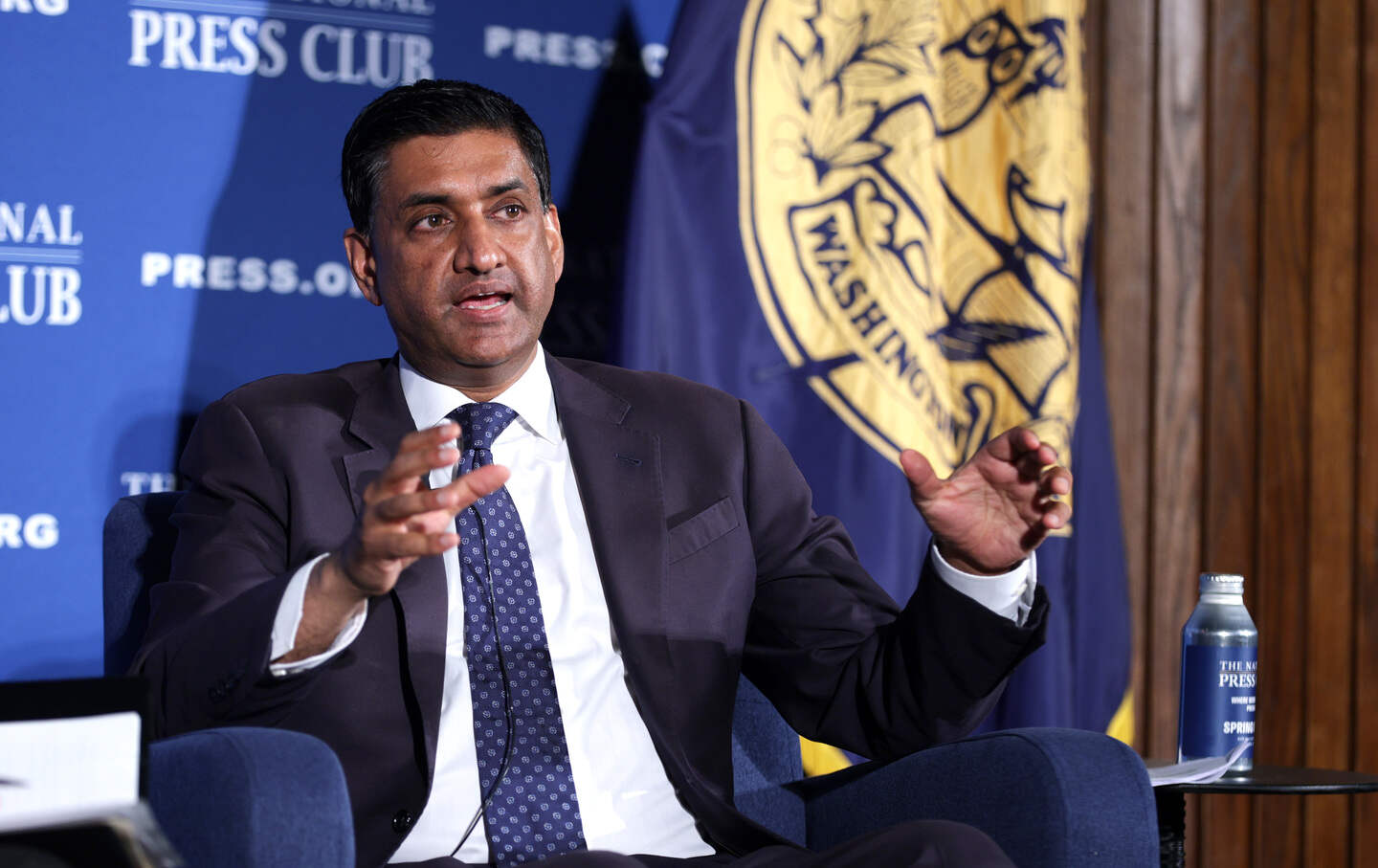
We need an AI revolution that works for the people, not just the billionaires. That’s Ro Khanna’s proposal. He’s the member of Congress who represents Silicon Valley. He’s also a leader of the Congressional Progressive Caucus. Last time we talked here was about a year ago, when we discussed Democrats winning back the working class by making the renewal of American manufacturing a top priority. Ro Khanna, welcome back.
Ro Khanna: Thank you for having me.
JW: You have an AI manifesto in the new issue of The Nationmagazine, where you say, “the AI revolution is destined to transform human society in ways that most of us cannot begin to fathom.” Please explain.
RK: Well, AI is going to have such a big impact on jobs. It already is having a big impact on jobs. A lot of tech companies are laying off folks. We’ve seen a Stanford study that shows a 16% decline in youth employment, people under 25. There is an anxiety over automation, excessive automation, whether it’s on a manufacturing factory floor, whether it’s white-collar jobs and customer service support, accounting, lawyers.
And then there is an issue about decision making: Who’s going to be making important decisions about war and peace, about whether we strike a target or not, whether someone should be free or in jail, whether we have a certain type of health care decision or not? All of that should have human judgment, not just be machines. So, it is a deeply transformative technology.
JW: Your manifesto declares we must regulate AI, so it is used to “improve humanity, not damage it.” Of course, the big question is what kind of regulations do we need? What are you proposing right now?
RK: I’m proposing big things on jobs, the most ambitious jobs agenda in generations. I modeled after FDR’s Works Progress Administration — I have a proposal for “Work for America”: We hire a million people, young folks, many of them who are right out of high school or college, to rebuild either their communities or to come and reimagine government and do moonshot projects in government, or to work in a community far from their home, to really understand and appreciate different parts of this country. I believe that can give us a new common mission. Economic renewal can be our new national purpose, and many people who are anxious about jobs could get a good paying job in the federal government. It worked for FDR. It can work for our time.
The second thing I would say is we need safety regulations. we need to expand the Department of Commerce – AI Safety Institute, really staff it — right now, Trump is cutting it — and not just give a blank check to the tech companies, but make sure that that AI is safe, make sure that it isn’t engaged in surveillance, make sure that it isn’t going to do evil things. And just like we regulate airline aviation or nuclear energy or electricity, we should be regulating AI.
JW: Given that Trump and the Republicans want no government regulation of AI, and given that they have the power to block anything Democrats in Congress might do, at least right now — right now, it’s up to the states to set guardrails. And, of course, Trump and the Republicans want to block that, too. But states have been active on this front, and I want to look at what some of the states are doing.
I asked the Google AI Gemini what states were doing to regulate AI. They said Colorado has the most comprehensive framework. The Colorado law specifically targets developers of what they call “high risk” AI systems, the ones that you’ve been talking about that influence decisions about employment and lending and health care and education. The Colorado law requires companies to implement risk management policies, to provide consumer disclosures, and to prevent discrimination. That goes into effect on June 30th.
California has done a lot of legislation about regulating AI. There are several significant laws that took effect on January 1st in California. One regulates developers of the massive cutting edge frontier models, the riskiest ones, which are required to publish risk information, report safety incidents, protect whistleblowers. It has penalties for failure to do this.
Texas passed regulations that also took effect on January 1st, banning AI systems that intend to manipulate human behavior, incite violence, discriminate against some people, or produce illegal deepfakes.
Trump and the Republicans want to ban all of this, of course, but are these the sorts of things you think should be national law, not just state laws?
RK: Well, of course we need federal laws because we need standards that are uniform, and where we have the expertise of the federal government to regulate it, just like we do for aviation, electricity and nuclear. But in the absence of that, we do need state laws because otherwise you would have no regulation and basically give these tech companies total freedom to do whatever they wanted. So ideally, we need strong federal regulation. But in the interim, we need state regulation.
JW: After I wrote a little piece about some of the problems with AI, I got an email from somebody who said they worked as a Search Quality Rater for Google, that they are given the results of Google searches, and they are given five minutes to assess the severity of harm to the user that might result from this information being released. Could harm be done, would it harm the user? Would it harm the entity? Including harm to their reputation? This is done by subcontractors. Google says they have thousands of independent contractors around the world who work as Search Quality Raters. Is this kind of risk evaluation good enough? Should we have more of it? What do you think?
RK: Well, we certainly need it, right? Consider if you were thinking about the French Revolution. Now the AI is scraping all the data available that may include novels and may include plays and may include people’s own interpretations. And then it will include certain histories. And the AI is just making evaluations of it. So there needs to be some interaction from scholars or people who are knowledgeable about the French Revolution to see that there’s some check to what AI is producing, which is why, ultimately, there may be more need for history majors and humanities majors in an AI world. But those are the types of standards that we need to have. And absolutely there shouldn’t be just a reliance on AI, without that quality check.
JW: I also asked Google AI what were the most vulnerable jobs? They said it’s the white-collar jobs that involve repetitive routine use of data — like bookkeepers, payroll clerks, customer support agents, technical writers, translators, paralegals, tax preparers. Can we, should we protect these jobs? Or what do you propose about the work and the lives of the people who are doing them right now?
RK: Well, first, we need bargaining with workers so that workers have a say in what they should do. In some cases, it may make sense to have these jobs. For example, I just today had the experience of going to CVS to get medicine, and they made me fill out all of these things on a screen before I could get my prescription filled. I found that totally a waste of time, and I still ended up having to rely on the pharmacist. So, you know, in certain cases, customer service is good, and we don’t want to just live in an automated world. There’s something with Daron Acemoglu, the Nobel laureate, called “excessive automation” that isn’t improving the customer experience or adding productivity. It’s just eliminating jobs. On the other hand, if there are certain things that we want to implement that improve productivity, then we want workers to have a say that they get moved to a different job, that they don’t get laid off, that they get not just training, but also the actual job. And so, what we need to do is make sure that the workers are getting the benefits of productivity.
JW: And another question is, what about the incredible wealth that’s being produced right now by the AI firms? Your district is the white-hot heart of the AI revolution. It’s also the wealthiest congressional district in the country. You explain in The Nation that your district is home of companies worth $18 trillion in market capitalization. More than a quarter of the entire U.S. stock market is based in your district. And you said five of your constituents are worth more than $1 trillion each. Now, they say they earned that money by, you know, being smarter and working harder than the rest of us. Is that the way you see it?
RK: Well, some of them did work hard, and I don’t take away from that. But we created the internet with U.S. taxpayer dollars through NSF, between Stanford and UCLA, in 1969, the first transmission, we created AI through our research universities like Dartmouth and ImageNet. With Stanford, we have created so much of the technology that these companies rely on through public tax dollars, through a dynamic federal government. So, they should acknowledge that debt to all of the taxpayers in giving them the technology that they were then able to commercialize. Second, a lot of the commercialization has come at the expense of ordinary Americans. They’ve taken data from ordinary Americans; they’ve engaged in stock buybacks. They’ve engaged in the offshoring of jobs to other countries to depress labor. There have been anti-union movements. So, I don’t take away from their pluck and entrepreneurship. But one has to recognize both the federal role in the creation of technology and the unfairness of a system that has really shafted a lot of people in the working class.
And that’s why I’ve said that I support a billionaire tax to make sure that we have health care and childcare and education for everyone — the chances that I had in this country — and to make sure that we have workers getting the benefits of this technology revolution.
JW: One more thing that you mentioned briefly: AI and the military, AI and war. The Trump administration has made a policy that they’re going to strengthen AI’s role in America’s military capability. I read that in the Iran war, Iran’s government launched drone strikes targeting Amazon Web Services, three data centers, two in the United Arab Emirates and one in Bahrain. Iran said these data centers were legitimate military targets, that the U.S. military uses AI systems hosted on Amazon Web Services. And apparently, the damage done to Amazon Web Services in the Mideast has been extensive. They suffered devastating direct hits, which are going to take months and maybe years to repair. So, Iran has showed that a data campus worth billions of dollars can be disabled by a drone costing a few thousand dollars. What do you make of that?
RK: It shows the asymmetric warfare currently that a lot of our legacy investments in defense — aircraft carriers and bombers and ships — just aren’t going to be what’s necessary to keep us safe in future warfare. I mean, Ukraine has shown that; Iran is showing that. And so, we need to rethink this kind of Pentagon bloat. We need to rethink having so many bases overseas and have strong national security. But that one is understanding the future of warfare, which is a lot of drones, autonomous vehicles, and how to be safe in that world.
JW: You conclude your piece for The Nationmagazine that you are “not an AI doomer,” you said, instead, you call yourself “an AI Democritizer.” Please explain.
RK: I believe AI technology can do incredible things. I mean, it can help us find cures for rare diseases. It can help find the cures to things like pancreatic cancer, be used to figure out what the mRNA vaccine was that just was announced. It can help us make things in an easier way and increase production. It can help us customize education.
But we need to make sure that AI is used to enhance human experience and worker productivity, not used to just eliminate jobs, not used to get young kids addicted to junk algorithms. Not used to just enrich the few. And that’s why a lot of what I, we, use the technology for needs to be with democratic values. Like any technology, it can be used for great good or for exploitation. And it’s the values that determine that.
JW: Ro Khanna, representative in Congress from Silicon Valley, author of “The AI Manifesto” – that’s the cover story in the new issue of The Nation magazine. Ro, thanks for all your work – and thanks for talking with us today.
RK: Always a pleasure. Thank you.
[BREAK]
Jon Wiener: Trump’s downward spiral continues; but as he becomes weaker, he becomes more dangerous. For comment, we turn to Harold Meyerson. He’s editor at large of The American Prospect. Harold, welcome back.
Harold Meyerson: It’s good to be here, Jon.
JW: Once again this week, the mainstream media headlines are that Trump is sending what they call “mixed messages” about his intentions in the war with Iran. That was the lead in the top story in The New York Times on Monday, and the page one headline at the LA Times on Tuesday. You know, sometimes Trump talks like a genocidal maniac: “A whole civilization will die tonight.” But then he declared last weekend in Phoenix that Iran had “agreed to everything,” including a plan to remove enriched uranium from the country. And he said, “there’s no need for fighting when there’s an agreement. Nice, right?” And of course, sometimes he tweets several times an hour. He’s been doing this for almost two months now. Are these mixed messages from Trump a negotiating strategy that is brilliant, or are they more like a sign of irrationality, or impulsivity, or something worse?
HM: The headline in The Washington Post today characterized his responses to Iran as “incoherent.” So there’s a growing sense, I would say, around town, but I think it’s really around the country, if not around the world, that he has become a creature of dissociated impulses, and that his impulse at 12:15 may be the opposite of his impulse at 12:20. And, the idea which was raised somewhat fancifully a while back about invoking the 25th amendment, because the president has lost it, as it were. It not only refuses to die, but it sort of gets a little more credence every day.
JW: I have to recall here that during a cabinet meeting in late March, Trump said, “I can’t say what we’re going to do, because if I did, I wouldn’t be sitting here for long. They’d probably, what is it called, the 25th amendment?” So, he is aware of these conversations.
HM: Yeah. Well, I think he’s aware of a lot of things, some of which, having been aware of, he nonetheless denies others, of which he will exaggerate. Many of these things that he’s aware of, again, at 12:15, he’s completely forgotten the existence of by 12:20.
JW: Meanwhile, the damage being suffered around the world is immense. The New York Times reported on Monday, “Even if there is a peace deal soon, Asia will likely see months of canceled flights, surging food prices, factory pauses, delayed shipments and empty shelves for products long considered quick and easy to buy worldwide: plastic bags, instant noodles, vaccines, microchips, and sportswear. If the war’s strangling of commercial traffic through the Middle East lasts even a few more weeks and uncertainty lingers, shortages could push several countries into convulsions of unrest and economic recession. Countless businesses are verging on insolvency. Governments are taking on enormous debt to slow inflation. By year’s end, millions across Asia could be pushed into poverty.” The New York Times. All because of Trump.
HM: America may no longer quite be the hegemonic power it once was, but it can be a hegemonic agent of chaos.
JW: Yeah.
HM: That seems to be what we have become. And the flip side of that, by the way, is that there are all kinds of regimes across the world that would, in theory, at least until recently, prefer American hegemony or pseudo-hegemony to Chinese hegemony or pseudo-hegemony. But Trump is working hard to tilt that towards China. China is certainly, at the moment, a greater guarantor of stability than the United States is. It’s hard to argue that it’s not, even if you are completely opposed, as I am to the Leninist capitalism that we have in China. This is aside from the fact that, Trump is short-changing science here, whereas China, is charging ahead on, on funding science. It’s really quite a distressing picture of the highest level of global relations.
JW: One of the things Trump is doing about this is trying to change the subject by talking more about his ballroom. The Washington Post noted that he has called public attention to his ballroom on about one day in three over the last year, and that ratio is increasing as the year has progressed. Seems like the goal here is to take attention away from the Iran war, but the public doesn’t really like either one. According to an Economist YouGov poll, 58% of Americans said they opposed tearing down the East Wing to build the ballroom. Only 25% of Americans supported building the ballroom. That’s even less support than there is for the war, which right now is something like 33%.
HM: In a sense, this is sort of Trump reverting to his pre-presidential mode of developing buildings that he can essentially slap his name onto. There was also a sort of a brief effort by the administration to note that since they were building underground offices under the ballroom, that this was therefore a matter of national security and therefore really shouldn’t be reviewed by whatever the commission is that is legally charged with reviewing this kind of development.
JW: I said 33% of Americans support the war right now. Elsewhere in the polls, there’s a new NBC news Decision Desk poll out Monday: 63% of Americans disapprove of Trump’s overall job performance; 50% say they disapprove strongly. That’s a sign that they’re going to vote for Democrats in the midterms. And it’s interesting that on the generic ballot, Democrats lead Republicans 50 to 43% among registered voters, which hasn’t been that big in quite a while. On prices, Trump’s net approval has fallen to what they call -46; the difference between support and opposition. This is the worst rating on any issue ever recorded in the history of American polling. What can Republicans do to change this situation before the midterms?
HM: Probably not enough. I would also add that, remember the chief indictment that Republicans leveled at the Biden administration, which therefore included Kamala Harris, was its unaffordability, that inflation was rising throughout Biden’s term and that things weren’t affordable. And so, the irony of this being Trump’s weakest issue is just overpowering.
As to the Republicans, Trump’s pretty much given up on winning on the issues and decided he could win by restricting the electorate — by forbidding mail balloting, even though tens of millions of Republicans vote by mail ballots. By gerrymandering, though Democrats have proved capable of counter-gerrymandering to match Republican gerrymandering. So, there’s kind of a surrender on the issue front, for lack of a better term. And there are all kinds of legal obstacles that the administration has encountered, including that it’s the states, not the federal government, which the Constitution entrusts the running elections to.
JW: I want to talk about the changes in his cabinet. You know, first he fired his Secretary of Homeland Security, Kristi Noem. Her campaign to deport immigrants who had committed no crimes and who had jobs and families, succeeded in turning a majority of Americans against Trump’s, what had been his strongest issue in the campaign, controlling immigration.
Then he fired his attorney General Pam Bondi. Her offense was failing to bring criminal charges against officials who had challenged Trump, like New York State Attorney General Tish James and Senator Adam Schiff.
Now, the news this week is that his Secretary of Labor is out, Lori Chavez-DeRemer. Not one of the higher profile people in his cabinet. What was her story there?
HM: Well, a sort of nonfeasance in office. Plus, her whole extended family seemed to be harassing younger women on the Department of Labor staff. Her estranged husband, maybe her boyfriend, and even her father in the allegations, which is kind of remarkable and kind of maybe a kind of a touching testament to family values. The family sweeps into power and all of its male members then start harassing the young women who work there.
JW: I have to add, she sent a text message to the employees saying they should “pay attention” to the requests of her husband and her father with the female staff members.
HM: That shows a nice degree of filial loyalty. Honor thy father and thy husband — by letting them run amok with the young women on your staff.
JW: So, the question is, who is next to is a candidate for a replacement on the cabinet? Do you have any candidates?
HM: Well, I do know that the three sacked members are all female. So, who’s left? There’s the wrestling czarina at the Department of Education.
JW: Linda McMahon, formerly CEO and co-founder of World Wrestling Entertainment.
HM: There’s the director of National Intelligence, Tulsi Gabbard. That’s the run of the females. Of course, if we’re assessing these folks on the kind of merit system that the Republicans insist is what we need to get back to in college admissions, I think the whole slew of them should go. But the cabinet meetings basically consist, as they never have before Trump, of Trump asking individual members to praise him. And given that, I have to think that there are some cabinet members who would actually like to be bumped so they don’t have to go through that ritual.
JW: You know, there’s been some suggestions that Kash Patel, director of the FBI, is a candidate for replacement. He sued The Atlantic for $250 million, a quarter of a billion, this week, for reporting that he has “alarmed colleagues by drinking, to the point of obvious intoxication” — a nice way of saying blackout drunk, or falling down drunk. Apparently he drinks at places like the Poodle Room in Las Vegas. I haven’t ever been to the Poodle Room. Have you?
HM: No, I’ve missed the Poodle Room in my Vegas excursions, I grieve to say.
JW: What do you think will happen with Kash Patel’s lawsuit against The Atlantic?
HM: Well, he may have reasoned that since Trump hates the media, that firing Patel would thereby validate The Atlantic’s claims. So, it may have been actually more of a strategic ploy to make it harder for Trump to fire him. And of course, if that’s the case, he can probably go on drinking at the Poodle Room to his heart’s content.
JW: On a more serious note, this Saturday, April 25th, Indivisible and its allies, led by Detention Watch, will hold a national day of protest against the expansion of Trump’s immigration prisons. These are the detention camps where people are held without charge after being picked up on ICE raids. Trump’s goal, of course, is one million deportations annually, and in order to accomplish that, Homeland Security is planning to open up maybe a couple of dozen new camps in the coming year, which will house 10,000 people each, they say. Usually these are in abandoned warehouses in smaller cities and towns.
Senator Jon Ossoff has been investigating the camps that are open. Since that investigation began, he says he’s received more than a thousand credible reports of human rights abuses, including mistreatment of pregnant women, separation of children from parents, physical and sexual abuse, overcrowding, and unhealthy conditions. The death rate is increasing. There’s been an average of more than one death a week this year in Trump’s detention prisons.
But the interesting thing is, in many places, local people have taken action to block the construction of these detention camps in their towns, including people in red states — in Mississippi, Oklahoma, Utah, Texas, Virginia; also New York, Maryland and Michigan. In Tennessee, the GOP candidates for governor, along with two dozen local Republican officials, successfully killed a project. So, a lot of these are red states. What is going on with the opposition to Trump’s detention camps in red states?
HM: It’s actually being paralleled, interestingly enough, right now in red states as well as blue by the opposition to building data centers all around the country. In red states, there’s a great support for Trump, less so, I think, for the oligarchs bringing AI to the rest of us — and therefore, there’s a spillover to the resistance in data centers, which also cause your electric bills to skyrocket. So we have two sort of interesting NIMBY kind of reactions to these two phenomena, you know, rooted in a whole variety of sources that go beyond some of the usual NIMBY objections.
JW: So, this Saturday, April 25th, is the Communities Not Cages National Day of Action, organized by Indivisible, the Detention Watch Network, Public Citizen, Move On, many other allies. You can find a protest near you @indivisible.org.
One last thing. It’s federal refund time. The Trump administration has begun the process of paying refunds to entities that were forced to pay his tariffs on imported goods. $166 billion is going to be refunded. But didn’t Trump say, “we’re not paying the tariffs. China is paying the tariffs”? So is the 166 billion being refunded to China?
HM: No, it’s not. But neither is it easily going to trickle down to consumers. That $166 billion is going to all the companies that raise their prices as a result of the tariffs. How many of those companies are going through the incredibly arduous endeavor of figuring out everyone who bought these products and refunding to them? It seems unlikely that that will be the case. I mean, I suspect the ideal compromise here would be if all those companies lowered their prices. But we have such a level of market concentration, and it’s difficult to see that online platforms like Amazon have any interest in doing this. So, God knows Jeff Bezos could afford it out of pocket. So, we’ll see where it goes. But I think we immediately hit the limits of trickle down, both in practice as well as theory.
JW: The limits of trickle down: Harold Meyerson. Read him @prospect.org. Thank you, Harold.
HM: Always good to be here, Jon.
Comments are closed, but trackbacks and pingbacks are open.