
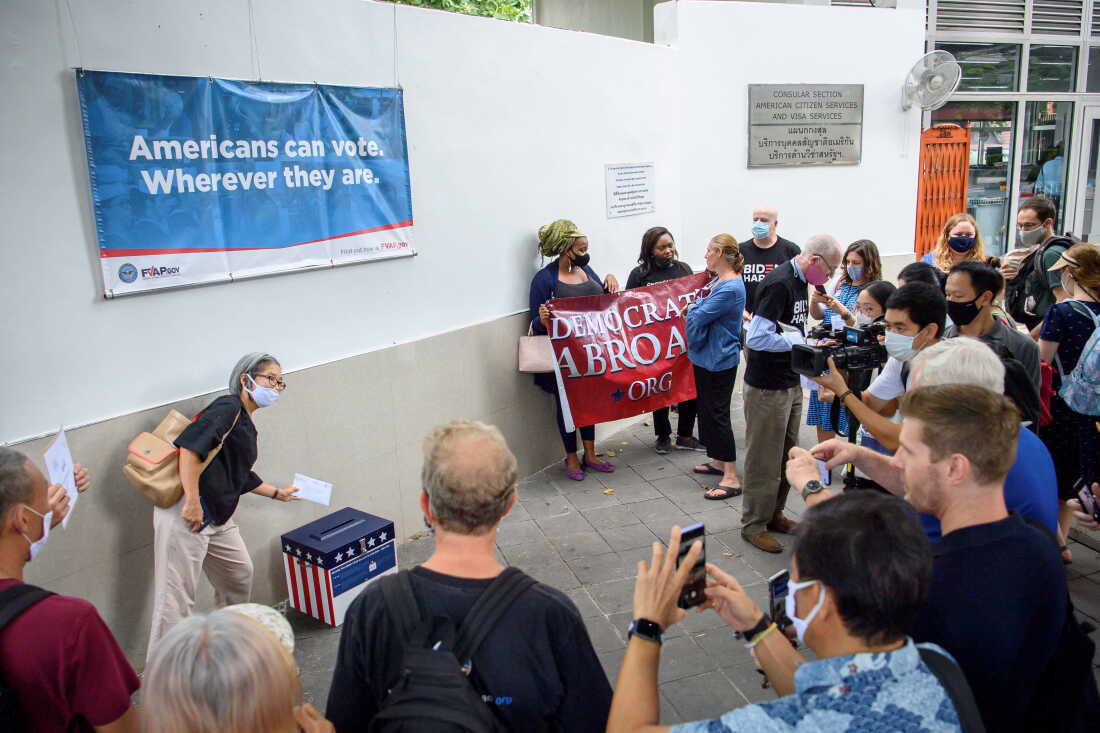
U.S. citizens who are members of the group Democrats Abroad gather to drop off their ballots for the 2020 presidential election into a box provided by the U.S. embassy in Bangkok in 2020.
Mladen Antonov/AFP via Getty Images
hide caption
toggle caption
Mladen Antonov/AFP via Getty Images
The Trump administration has made last-minute changes to key absentee-voting forms for U.S. citizens living abroad, raising concerns about confusing some overseas voters during this year’s midterm elections.
The revisions to two forms came in late August from the Pentagon. The department runs the voting assistance program that provides forms allowing eligible overseas citizens, plus U.S. military members and their families, to register for and participate in federal elections.
Weeks before a Sept. 19 deadline for states to send those voters midterm ballots, the Pentagon submitted “emergency” requests to bypass the usual months-long process for changing federal forms.
Among the changes was removing a checkbox for an overseas U.S. citizen to identify as having “never lived in the United States.”
The removal leaves only two response options for those without an active-duty military connection. Both options require overseas citizens to make a sworn declaration: Either they intend to return to the U.S. or are uncertain about returning.
But some U.S. citizens who were born abroad have never lived in the United States at all.
Many states and Washington, D.C., allow what are often referred to as “never-resided” citizens to vote if they have a relative who last lived in that state or territory before leaving the U.S., including a parent or legal guardian serving in the military.
Since 2024, however, Republican officials have been pushing to block these U.S. citizens from voting.
In lawsuits, GOP officials have argued state laws and other rules permitting voting by never-resided citizens violate state constitutions. They also have claimed in court filings that these U.S. citizens are disproportionately registered as non-Republican voters and allowing them to cast ballots hurts GOP chances of winning elections.

While Republican court challenges have been successful in North Carolina, they have been rebuffed twice in Michigan as similar lawsuits continue in Arizona and at least five other states.
For now, eligible never-resided voters can continue to register and request ballots through any alternative ways provided by the state or territory where they are eligible to vote.
And the Pentagon’s Federal Voting Assistance Program (FVAP) says state election officials can keep processing previous versions of its forms. Asked by NPR how long that can continue, the Pentagon said in a statement: “States administer elections and can process any form or application that provides the information required to verify a voter’s eligibility to vote in their jurisdiction.”
Still, many overseas and military voting advocates are worried the new federal form changes, which were reported earlier by the outlet Democracy Docket, are setting up the latest hurdle to the ballot box for U.S. citizens living abroad.
Trump officials removed an overseas voter category that’s been on forms for more than a decade
Some version of the checkbox for never-resided voters has been on what’s known as the “Federal Post Card Application” and the “Federal Write-In Absentee Ballot” since 2013.
“I actually worked that regulation to change the form. But I didn’t want to do it right in the middle of the 2012 election, so I had it effective come 2013,” says Bob Carey, a retired U.S. Navy captain who led FVAP until departing in 2012.
Carey recalls the idea of adding a category for never-resided voters came from some state election officials and overseas voting advocates.
“At the time, I was sort of saying to myself, ‘OK, this won’t make that big of a difference. I’ll add the block,’ ” Carey adds.
But more than a decade later, the Pentagon says it has changed its interpretation of a federal law known as the Uniformed and Overseas Citizens Absentee Voting Act.
“It has recently come to our attention that the current format of these forms may confuse voters about the information they are required to provide under Federal law and their eligibility to use these forms to register and vote,” Sean O’Keefe, the Pentagon’s deputy under secretary for personnel and readiness, wrote in a letter about the August emergency requests for changing the forms.
It’s not clear what exactly prompted the Pentagon to reassess these forms, which now also include revised language about voter identification.
But days after a White House agency approved the requests, FVAP said the forms “have been updated” in social media posts. The Pentagon started a public comment period about each form more than a week later. And guidance for state election officials was not posted on FVAP’s website until about a month after the forms changed.
In a statement, the Pentagon said FVAP has also directly notified election officials and voters by email, though it provided no additional details.
Some military and overseas voting advocates say the Pentagon should do more outreach in the middle of voting season for the midterm elections.
“If I was the under secretary of defense for personnel readiness, to which FVAP reports, or the secretary of defense, I’d be calling up the [FVAP] director and saying, ‘Spam the crap out of everyone,’ ” says Carey, who now serves as executive director of the National Defense Committee, a veterans advocacy organization focused on voting and other civil rights.
Overseas voting advocates worry the changes will cause — not eliminate — confusion
Sarah Streyder, executive director of Secure Families Initiative — a group that advocates for military families and challenged President Trump’s failed push for mail-in voting restrictions for the midterms — says she’s concerned about the lack of transparency surrounding the Pentagon’s process for changing the forms.
“What were the voices prompting this change? Where did this come from? Military families are stakeholders who should have been included, because we can speak most authoritatively on what truly causes confusion with these forms and what doesn’t,” Streyder adds. “That’s our form you’re messing with. And you didn’t even ask us for the input. It’s just very insulting.”
The Pentagon emphasized in a statement that the forms were changed to “eliminate voter confusion.”
But Susan Dzieduszycka-Suinat, president and CEO of the U.S. Vote Foundation, an advocacy organization for overseas voters, says she expects the opposite to happen.
“I definitely believe that the new version of the form will create far more confusion than we ever encountered with any previous version,” Dzieduszycka-Suinat says. “The law hasn’t changed. States still run this program the way Congress wrote it. However, the fact that it’s being presented differently at the federal level within this 90-day window [before Election Day] — it doesn’t give the states time to implement it, to train their people, to inform voters, to change instructions or any of it.”
Dzieduszycka-Suinat notes these last-minute changes to the forms come shortly after the Republican National Committee ramped up its legal fight this year against state laws that allow never-resided citizens to vote, including in Colorado, Nebraska, Nevada, New Jersey and Virginia.
“It’s hard to ignore the fact that a spotlight has been shown onto this particular slice of voters,” Dzieduszycka-Suinat says. “And it’s very concerning that they’ve simply been wiped off the form without discussion.”
Edited byBenjamin Swasey
Comments are closed, but trackbacks and pingbacks are open.