
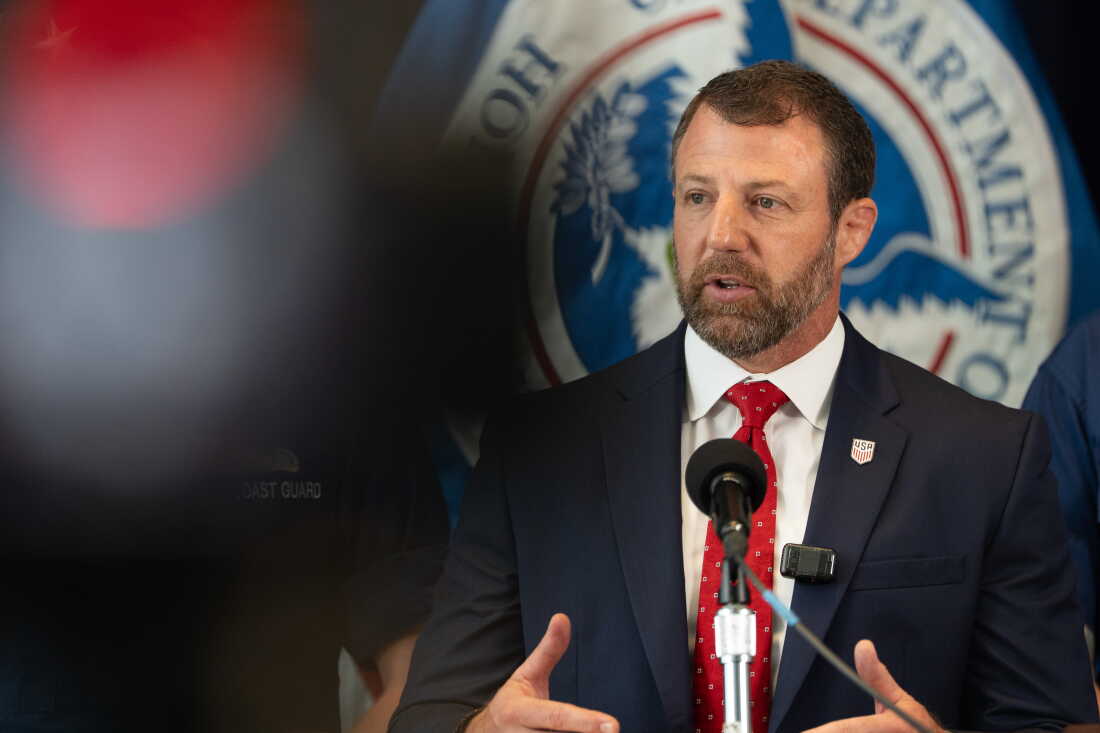
Homeland Security Secretary Markwayne Mullin speaks during a news conference July 1 in New York.
David Delgado/AP
hide caption
toggle caption
David Delgado/AP
The U.S. Supreme Court has for now revived a federal data system the Department of Homeland Security revamped into a tool to check the citizenship of millions of Americans on state voter rolls. The tool has mistakenly flagged some eligible voters as potential noncitizens.
The news comes as the Trump administration has been pouring resources into searching for noncitizens on voter rolls ahead of the upcoming election.
Many states uploaded their voter lists to the expanded version of the Systematic Alien Verification for Entitlements data system — known as SAVE — sharing that voter information with the federal government. Tens of millions of voter records were run through SAVE before it was blocked by a federal judge in Washington, D.C., in June.
The Supreme Court’s decision clears the way for the administration to again use the revamped SAVE in its hunt for noncitizens on voter rolls, as well as in its unprecedented project of compiling lists of adult citizens in each state.
Any impact on the midterm elections is unclear. Federal law bans states from “systematically” removing voters from rolls within 90 days of a federal election.


The Trump administration and Republican state officials have argued that statute should not apply to removing noncitizens who were improperly registered. And the federal government argued to the Supreme Court that at a minimum, the updated SAVE should be able to be used for individual removal decisions ahead of an election.
In siding with the Trump administration, the court’s majority wrote that the lower court order that halted the expanded SAVE prevents the federal government “from using the modified SAVE program to conduct individualized inquiries, which are permitted under federal law during this [90-day] period. The District Court’s order thus inhibits the Federal Government’s efforts to assist state and local agencies in the proper administration of the midterm elections.”
The Supreme Court’s three liberal justices dissented from the ruling, and would have denied the Trump administration’s stay application.
Justice Ketanji Brown Jackson authored the dissent, writing about the “majority’s omission of any consideration of the harms that might occur if the modified SAVE system is allowed to continue operating. The District Court highlighted such harms, noting the risk that States might cancel the voter registrations of at least some recently naturalized citizens or force such persons to provide proof of citizenship before voting.”
The coalition of organizations that challenged the SAVE overhaul last year, which includes the League of Women Voters and the Electronic Privacy Information Center, put out a statement on Friday that said litigation in the case is ongoing.
“Today’s decision is profoundly disappointing, as it puts millions of Americans at risk of being unlawfully targeted by the administration’s unreliable voter purge database weeks before the midterm elections,” the statement reads. “However, this case is not over. The D.C. district court ruled that the expanded SAVE program violated multiple laws. We will be doing everything in our power to protect Americans’ voting and privacy rights by ensuring that the district court decision stands.”
How the Trump administration overhauled SAVE
SAVE is a 40-year-old federal data system that was created to check the immigration status of noncitizens to determine their eligibility for public benefits.
Then, DHS overhauled SAVE last year by linking it for the first time with Social Security Administration records, which include most Americans. The overhaul also allowed bulk queries to SAVE, and DHS encouraged states to upload their entire voter rolls to SAVE to verify those registered are U.S. citizens and not listed as deceased in federal records.
In June, U.S. District Judge Sparkle Sooknanan, a Biden appointee, blocked use of the modified version of SAVE, finding that its aggregation and disclosure of sensitive data violated the Social Security Act, the Privacy Act and the Administrative Procedures Act.
“The federal government has knowingly trampled on the privacy rights of American citizens in a manner that threatens the sacred right to vote,” she wrote.

After an appeals court panel refused to stay the lower court’s decision in a 2-1 vote, U.S. Solicitor General D. John Sauer appealed to the Supreme Court earlier this month.
In his appeal, Sauer wrote that since May 2025, the updated version of SAVE has verified more than 65 million voters across 26 states, and has flagged 28,635 as potential noncitizens.
“The district court’s order, however, makes it harder to detect ineligible voters, undermining the integrity of federal elections and public confidence in the results of those elections,” he wrote.
The League of Women Voters and the Electronic Privacy Information Center — which are represented in the case by Democracy Forward, Citizens for Responsibility and Ethics in Washington and the Fair Elections Center — argued in a brief to the Supreme Court that Congress has not authorized the federal government to create a “master database of U.S. Citizens,” nor does it have data that could do that accurately. The brief added that multiple statutes restrict repurposing and sharing Americans’ sensitive data.
“Disregarding these laws, the government has recklessly created an error-laden master citizenship database that endangers millions of Americans’ privacy and voting rights,” the groups wrote.
They wrote that even though 65 million voters had been verified by the revamped SAVE, the government had not yet released the system’s error rate, or how many Americans’ citizenship was misrepresented “and who consequently have been forced to reverify their citizenship to retain their voter registration or obtain government benefits.”
SAVE has mistakenly flagged eligible citizens
Even though Election Day is just over a month away and voting is underway, the Trump administration could try to make use of the expanded version of SAVE right away in its quest to check registered voters’ citizenship.

An executive order President Trump signed in March calls for federal agencies to consult SAVE data, along with other federal records, to create state-by-state lists of adult U.S. citizens. The same order directs the U.S. attorney general to prioritize investigating and prosecuting election officials who provide ballots to ineligible voters. Even though the executive order says such state lists are to be completed 60 days before an election and that deadline has already passed, federal officials have indicated the project is still underway – although it is facing a legal challenge.
Eligible voters have been erroneously flagged by SAVE, which has been unable to confirm the citizenship of certain categories of foreign-born people who become U.S. citizens.
After Texas ran its entire voter list of 18 million voters through SAVE, the system flagged 2,724 voters as potential noncitizens. County election officials then gave those individuals 30 days to prove their citizenship and, following state law, removed anyone who did not respond in time.
As NPR first reported in December, that effort resulted in citizens being removed from the rolls. Anthony Nel, whose story NPR highlighted in that reporting, gave a declaration in this lawsuit.
A recent press release from the Texas secretary of state revealed that of the 2,724 voters that were initially flagged by SAVE as potential noncitizens, some 20% were later found to be citizens who were reinstated. The same release said the office referred 117 cases identified by SAVE, or 4.2% of those flagged, for investigation for possible noncitizen voting.
Comments are closed, but trackbacks and pingbacks are open.