
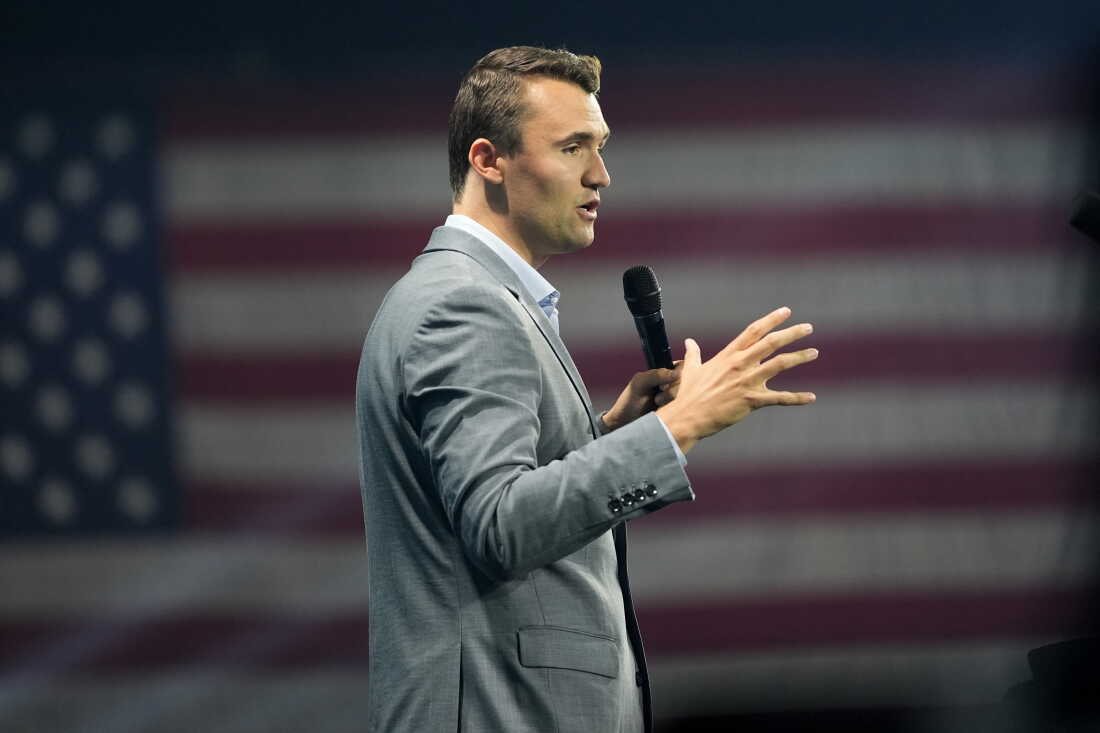
Charlie Kirk speaks at Turning Point’s Believers’ Summit on July 26, 2024, in West Palm Beach, Florida.
Alex Brandon/AP
hide caption
toggle caption
Alex Brandon/AP
When Jacob York found out that Charlie Kirk had been fatally shot, he was at baseball practice. Standing in the outfield, he broke down in tears. That night, he decided that Kirk’s organization, Turning Point USA, should have a chapter on his campus. So he got to work starting one himself.
“I feel like there [were] many of us who had that wake-up call,” said York, 21, who attends Olivet Nazarene University, a small Christian school south of Chicago.
“I think I submitted the request to start a chapter six times,” he recalled. “There were so many requests that it kept saying, ‘Oops, try again later.'”
Kirk’s death one year ago on the campus of Utah Valley University was as stunning for his followers as it was painful. A little more than a decade earlier, he had founded Turning Point with the goal of getting more young people involved in conservative politics. By the time he died at age 31, he had become one of the most revered figures on the right, especially among Generation Z and millennial conservatives.

From students like York all the way to the upper echelons of the Republican Party, Kirk’s death was seen as a call to action. In the days following the shooting, Turning Point reported an initial surge of interest among college and high school students looking to start chapters.
His widow, Erika Kirk, spoke about that momentum in her first public remarks, just days after his death.
“If you thought that my husband’s mission was powerful before, you have no idea,” said Erika Kirk, who has since taken over as Turning Point’s CEO. “You have no idea what you’ve just unleashed across this entire country, and this world.”
But, as Charlie Kirk’s young supporters reflect on the past year, some paint a more complicated picture of the organization he left behind. Rather than a unified and growing coalition of young voters, they describe a movement facing questions about its future — one that has yet to fully coalesce around a new leader and that is grappling with the same issue divides causing friction within the Republican Party more broadly.
Fractures amid growth
The fractures have been felt acutely by young conservatives like 23-year-old Dino Fantegrossi.
“Charlie Kirk got it. He spent all of his time on college campuses talking to people my age, whether he agreed or disagreed with them,” said Fantegrossi. “He knew — because he was so plugged in — what bugged young people, what needed to be addressed. There’s no one else that was quite at that level of plugged in.”
Fantegrossi, a recent graduate of the University of Arkansas, had led his school’s Turning Point chapter for more than two years. That is until last spring, when he decided to break with the organization and start a new group, Young American Revival, which he said aims to be “a positive vehicle for students to take out their frustrations in a manner that actually brings about change within our state.”

A U.S. flag is displayed in memory of Charlie Kirk on the campus of Utah Valley University in Orem, Utah, on Sept. 19, 2025.
Melissa Majchrzak/AFP via Getty Images
hide caption
toggle caption
Melissa Majchrzak/AFP via Getty Images
“One of the big problems that has happened since Charlie’s death is that I think a lot of the youth have kind of felt lost,” said Fantegrossi. “They’re not really sure how to channel their frustrations, and that oftentimes — when it’s not put in check or pointed in a positive direction — can manifest itself in some very nasty ways.”
In a statement, Turning Point spokesman Andrew Kolvet acknowledged that the group is facing “a confluence of challenges” but attested that “the organization is still growing in nearly every conceivable way,” saying it’s “a testament to Charlie’s enduring legacy.”
Turning Point says in a fact sheet that it saw “unprecedented expansion” in the 2025-2026 school year, with over a million involved students across 3,500 high school clubs and 1,500 college chapters.
“In many ways the challenges our students and chapters face have never been more obvious or pronounced, but so too are the opportunities,” Kolvet said.
A missing leader for young conservatives
At the time of his death, Kirk was seen as one of the most influential voices within the conservative youth space and broader Republican Party. Supporters have credited him for the gains that then-candidate Donald Trump made with young voters in the 2024 presidential election, a crucial bloc that helped propel him to a second term.
Kirk’s influence extended into Trump’s second administration, as Kirk maintained close relationships with top White House officials while continuing to engage with the Make America Great Again movement’s newly expanded youth coalition.
For his followers, his influence meant their views had a direct pipeline to the president. For the administration, he was a trusted messenger on policy decisions, even when they split the MAGA base, as with the strikes on Iranian nuclear facilities in the summer of 2025.

Donald Trump walks onstage after being introduced by Charlie Kirk at the Turning Point Action conference on July 15, 2023, in West Palm Beach. Before his death, Kirk was a key conduit between young conservatives and Trump’s White House.
Joe Raedle/Getty Images
hide caption
toggle caption
Joe Raedle/Getty Images
But for as much as Kirk was revered on the right, he was reviled on the left, facing pushback for comments disparaging immigrants and transgender people and questioning the qualifications and capabilities of women and Black Americans. He also amplified conspiracy theories about COVID-19 and falsely claimed the 2020 presidential election was fraudulent.
The criticism did not faze Kirk, as he visited campuses across the U.S. to debate his positions at “Prove Me Wrong” events that were central to the image he cultivated for himself as a defender of free speech, free markets and limited government. It was the same type of event he was taking part in last year when he was assassinated at Utah Valley University.

“He was unique in terms of his connection to a not-insignificant number of younger people,” argued John Della Volpe, a Democratic pollster who has spent decades researching young Americans.
Della Volpe, who observes and conducts focus groups of Gen Z voters, said Kirk’s death could be another factor fueling a growing belief among young people that they lack political agency.
“His name is mentioned on an ongoing basis, literally every single month. But it’s framed as ‘He was someone who understood me, who heard me,'” Della Volpe added. “People feel like he listened to them and he’s been taken from us. So therefore, why does it matter anymore?”
The divides playing out within Turning Point
That kind of direct connection has felt missing for many of Kirk’s followers. Turning Point leaders vowed to continue holding campus visits in Kirk’s stead, organizing more formal events that largely veered away from direct debate and instead featured a range of keynote speakers, including the group’s new leader, Erika Kirk, and Vice President Vance. But the events have drawn mixed and, at times, lackluster turnout.
Filling Kirk’s shoes isn’t the only challenge facing Turning Point. There’s also the daunting task of keeping young conservatives engaged at a time when many of them are unhappy with party leaders.
That includes Trump, whose youth coalition has increasingly soured on him. At the start of his second term, 92% of Trump voters under 35 approved of his job as president, according to data from Pew Research Center. By late April 2026, that support had dropped to 57%.

People attend a Turning Point USA event at the University of Mississippi on Oct. 29, 2025.
Pool/Getty Images
hide caption
toggle caption
Pool/Getty Images
Student organizers say the Iran war and the administration’s relationship with Israel have been major tension points. Gen Z and millennial Republicans are much less likely than older generations to hold favorable views on both topics.
To Hazel Roberts, 18, a first-year student at Grand Canyon University who started a Turning Point chapter back in high school, these intraparty rifts are a painful reminder of why Kirk’s leadership mattered.
“That’s what Charlie loved about Turning Point. We could all have different perspectives and not hate each other for it, and we can talk about it. And since Charlie’s passing, there has been a lot of hate from the right,” she said. “Charlie was the glue that held us together.”
Misinformation about Turning Point could cloud its future
The divides go past just policy rifts, and for some student activists on campus, they had made organizing efforts more of a challenge.
“The conspiracies revolving around Charlie Kirk’s assassination [have] really tanked the credibility of Turning Point,” said Alex BirdSong, 19, a junior at Georgia State University, referring to the slew of unfounded claims made by right-wing influencers, namely podcaster Candace Owens, to millions online over the past year.

BirdSong, who joined his school’s Turning Point chapter following Kirk’s death and now serves as its president, hopes that this school year he can help change how people think about the organization.
“We’ve had people come up to us who are Candace Owens fans and get mad at us for being Turning Point, and so that’s what the climate is,” he explained. “It’s going to be a huge challenge for Turning Point and the right if, one, the right can’t unify and, two, if the [Trump] administration can’t get the controversies under wraps.”
Some students admit that the confluence of challenges has caused momentum to fizzle.

Turning Point USA CEO Erika Kirk speaks during a Turning Point event at Dream City Church in Phoenix on April 17.
Win McNamee/Getty Images
hide caption
toggle caption
Win McNamee/Getty Images
“I would say the interest in conservative organizations is low right now, even if it did rebound when Charlie Kirk got shot,” said Max Williams, 20, a junior at the University of Richmond, where he leads the school’s Turning Point chapter. “I think that Charlie not being there, the Trump administration not being popular right now — I think that it is definitely slowed down a bit and maybe even is going in the opposite direction.”
Williams said there’s a part of him that’s not excited to participate in organizing on campus again this year, as he too has grown frustrated with Trump.
“Some of this stuff is just infuriating, and you can’t defend any of it. And I don’t even try anymore,” he added.
His plan for talking with students on campus: Emphasize the issues they care about, instead of focusing on Trump.
But without Kirk, that might not be as easy as it once was.
Comments are closed, but trackbacks and pingbacks are open.