
You really do see him everywhere. He’s there on your California driver’s license, on every state flag and on your UC Berkeley merch.
You find him on the official state seal, and if you get nabbed speeding on the freeway, there he is, embroidered on the CHP officer’s uniform patch.
If California ever printed its own money, he would be on it.
He’s the California grizzly bear, and you see him pretty much everywhere, except alive and thriving in California.
In the span of a single human lifetime — between the Gold Rush and Prohibition — we killed them all. Killed them? More like we exterminated them. Shot them for fun and for fur. Poisoned them for carrying off a farmer’s pigs or calves, or because they might try to do it. Trapped them to chain them up in an arena and gore them to death by a bull, to provide an afternoon’s entertainment.
We have a lot to atone for. And maybe that’s one reason that there’s talk of bringing the iconic bear back to the Golden State. More on that later.
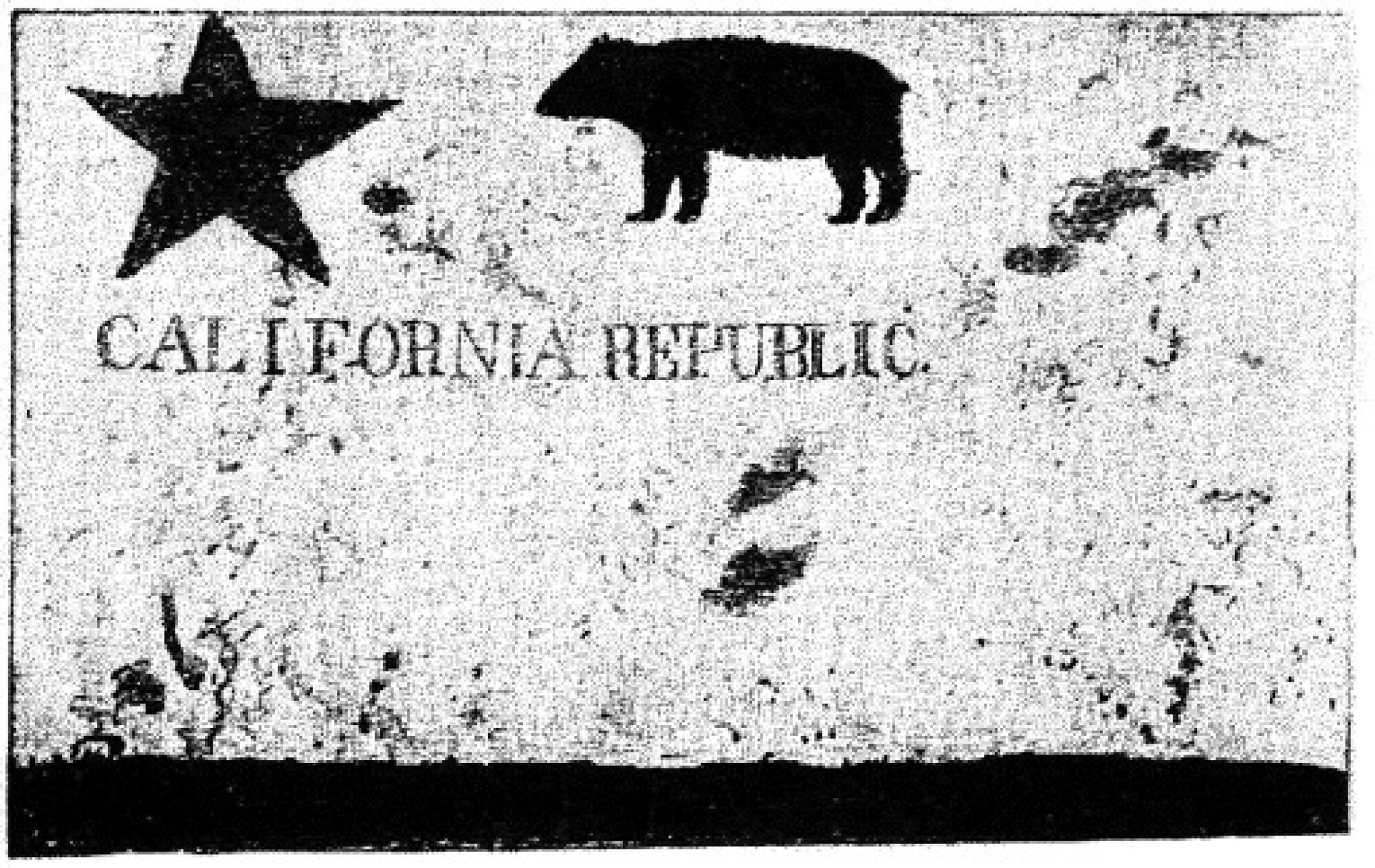
The California grizzly is so important to our self-image that 180 years ago, we put one on the flag that evolved into the state flag. The original 1846 “bear flag” banner was a thrown-together affair, a handmade one, perhaps a bit drunkenly assembled.
It was banded on the bottom in red — maybe from a red petticoat or long johns, per the man who says he designed the flag, one William Todd, nephew by marriage of a young Illinois congressional candidate named Abe Lincoln. The single star was painted in berry juice, as was the bear, which looked so porcine that Mexicans who were struggling to protect California from Yankee rogues mocked it as more pig than bear. The words “California Republic” were painted in black ink with the chewed end of a twig.
Historic California Bear Flag as photographed in 1890. According to the California Blue Book: “The flag was designed by William Todd on a piece of new unbleached cotton. The star imitated the lone star of Texas. A grizzly bear represented the many bears seen in the state.”
(The Museum of the City of San Francisco)
The California Republic lasted 25 days. The original flag lasted 60 years, until it burned up in the San Francisco earthquake and fire.
Why is it up for discussion again?
An Inglewood Democrat, state Sen. Laura Richardson, has proposed a measure to study the possibility of restoring the iconic bear — not a date certain for putting claws on the ground, mind you, just an unfunded bill for a “roadmap” study by the state fish and wildlife department to evaluate “whether, and under what conditions, reintroduction of the grizzly bear is feasible and advisable.”

2024 California’s Senate District 35 candidate Laura Richardson.
(Courtesy of Laura Richardson)
I left a message for the state senator’s office, wanting to know more about what must be a fascinating backstory to this urban legislator’s measure, but like the population of California grizzlies, I scored zero.
A grizzly revival study is an easier matter for science than for politics, with hunters and ranchers already against and environmentalists and some native American tribes for.

Workers box up the bronze grizzly bear in front of the Governor’s Capitol office for relocation to the governor’s temporary office in Sacramento, Calif., Friday, Nov. 19, 2021. The sculpture was purchased by former Gov. Arnold Schwarzenegger in 2009.
(Rich Pedroncelli / Associated Press)
For a long time, the California grizzly was regarded as its own distinct sub-species, Ursus arctos californicus, but now science is not so sure. A genome for the California grizzly exists, but refashioning living bears might require an assist, Jurassic Park-fashion, from its closest shared ancestor [only as close as 10,000], Yellowstone’s brown bears, or from the nation’s small surviving grizzly populations in Alaska, Wyoming, Montana, Idaho and Washington.
Extinction panic had already set in among California naturalists within months of the very last grizzly being shot to death. In September 1925, the state fish and game commission was desperately calling for help from anyone who knew where to find a living pair of grizzly bears “to be considered as the nucleus of breeding stock to perpetuate this famous species as part of the fauna of the grizzly bear state.” The sighting of even a solo grizzly “should be immediately reported” to the state.
The “last grizzly killed” has several claimants: In Orange County, it was in February 1908, when a huge steel trap was laid for a bear that had been stealing honeycombs from hives. The bleeding bear dragged the trap for miles, chased by men and dogs, and was at last shot to death.
In October 1916, in Tujunga Canyon near Sunland, a farmer named Cornelius Johnson set out a trap for a bear that had been raiding his grapevines.
Grizzly bears are — were — omnivores, not picky eaters, and also lazy ones, noshing on berries, roots, acorns, beached whale carcasses and any laggardly young elk. Once farmers and ranchers arrived in California, their stock of calves and pigs and crops were a bear buffet, and that got bears killed much more often than any unprovoked attacks on humans.
Anyway, Johnson had chained a log to the bear trap, and the small injured bear dragged herself and the log for almost a mile as Johnson and his neighbors pursued her and shot her to death. “Taste for honey and grapes fatal,” The Times wrote. The neighborhood celebrated with a bear meat barbecue.

An October 1916 L.A. Times story on Cornelius Johnson of Sunland and the “cinnamon bear” he killed.
(Los Angeles Times)
It turns out that the bear he killed had been captured as a cub and kept on display in a bear pit at an Echo Mountain hotel. She escaped in 1901 and roamed the San Gabriels until Johnson shot her.
The last documented California grizzly killed was hunted down in August 1922 by a Tulare County rancher named Jesse Agnew, who blamed his dead calves on the grizzly. 1922 was also the year that the federal biological survey said it would begin protecting bears that were not killing livestock, but farmers still killed bears proactively – sooner or later, they figured they would kill livestock.
When C. Hart Merriam, an ethnologist and mammologist, got wind of the Agnew bear, he wrote in a Sierra Club circular in January 1925 — Agnew was a longstanding Sierra Club member — pleading that Agnew send him even a fragment of the skull.
‘’You may not realize the sad fact that of the hundreds of Grizzlies killed in the Sierras, not even a fragment of a skull is known to exist in any museum or private collection … the value of the skull is beyond words to express.” Agnew mailed Merriam a single tooth, but the bearskin had already been sent to someone in Korea.
That same year, the state fish and game commission’s newsletter put out a desperate plea for anyone finding a living grizzly, or better yet, a couple, “as the nucleus of breeding stock to perpetuate this famous species as a part of the fauna of the grizzly bear state.”
Too late.

Vintage postcards depicting California extinct grizzly bear, from the private collection of Patt Morrison.
(Patt Morrison)
Thus the California grizzly joined the passenger pigeon, the most populous bird on earth, on the extinction list. Passenger pigeons, native to North America, were counted not by individuals but by how many hours or days it took a single flock to pass overhead. In 1813, in Kentucky, the ornithologist John James Audubon calculated that 300 million birds an hour flew above him, times 24 hours, for three solid days. In 1871, one massive flock in Wisconsin nested more than 850 square miles — almost twice the size of the city of L.A.
Passenger pigeons were killed for sport — who can kill the most? — and for food. In 1878, in Michigan, hunters suffocated or shot 50,000 nesting birds a day for about five months and shipped them to cities and towns, where they sold as poor people’s food for a penny or two each.
The pigeon beat the California grizzly to the grave. The last of them died of old age in a zoo in 1914.

Vintage postcards depicting California extinct grizzly bear, from the private collection of Patt Morrison.
(Patt Morrison)
What is the “recipe list” for bringing back such a bear?
Rick Bass is a writer, a former wildlife biologist and geologist, an environmental activist, and program director for the Montana Project, which helps artists advocate for open space and conservation.
He wrote the foreword for the scholarly book “California Grizzly” and from his Montana home keeps an eye on the well-being of his home state’s precariously small colony of grizzlies.
He agrees that “quixotic” is a good word for the Richardson legislation, but says that “a study is never a bad thing. More knowledge and more science will benefit lay people and the issue.”
Restoration would “require deep patience to return them. You can’t go back in time. 21st century California is not the California of the 19th century.” It would be “a generational project, but that’s okay. It took a generation or two to get rid of them; it can take the same to bring them back.”
He thinks the first imperative is that tribal voices be heard, in no small part because they “had their relationship with wildlife taken from them.” And then there’s just how enormously California’s natural places have altered and disappeared in the century since the last grizzly was killed.

Sturdy the Bear is immortalized at the entrance of Memorial Stadium at UC Berkeley.
(Don Feria / For The Times)
Unless you just plan to reintroduce bears to the outdoor equivalent of a zoo enclosure, thoughtful habitat planning has to come first, says Bass, for a “fuller ecosystem.”
“Anybody can helicopter a grizzly into the Trinity Alps, but that’s an indulgence. Having a habitat they can get into and out of on their own is what makes them a grizzly bear, and that’s what would need to be preserved.”
“I would work on connectivity, [wildlife] corridors that would have a genetic flow, and the bears that could have the skill sets to get there without mortality or mayhem.”
Climate change, land use pressures and drought would all have to be reckoned with. “It’s not an easy thing to keep a grizzly bear alive in the 21st century. That doesn’t mean we shouldn’t attempt it, because they are so foundational to whatever ecosystem they were found in and helped to shape with their presence.”
It didn’t save them a hundred years ago, but it could help their return that grizzlies “do not like people. They don’t like the sound of people, they don’t like the sight of people, they don’t like the smell of people. And it’s not rocket science, as we are learning, to protect livestock from grizzlies and wolves,” Bass points out.
“Bears don’t like conflict. They like it easy. So the livestock issue, while fear is a real response if you are a livestock producer, can be mitigated … that’s not a deal breaker.”
Native Americans more or less cohabited peaceably with the grizzlies, each usually giving the other wide berth, at a mid-19th century ratio of about 10,000 California grizzlies to 130,000 native Americans.
The Yankee Americans crowding in were the greater aggressors. George Yount, whose name adorns Yountville, wrote of seeing 50 or 60 bears one day, and killing five or six of them. A San Luis Obispo man reputedly killed 45 in one year just to show off his shooting skill and left the bodies to rot where they lay.
Spanish, Mexicans and Yankees delighted in using bears for entertainment. Two horsemen would rope a grizzly — one by the head, one by the hindquarters, and the horses pulled until the bear was dead. “The fun was kept up until about daylight,” according to an 1898 California history book.
Sacramentans put grizzlies in an arena with donkeys to watch the bear tear off the other animal’s head or legs. Lacking a donkey, the “California Grizzly” book said that locals dumped rats in a “well-closed arena” for the fun of watching them swarm the bear, tormenting him until he dropped.
A New England frontiersman and ‘49er called “Grizzly Adams” — a name we likely know from a 1970s television show — tamed and trained a couple of young grizzlies as his companions. He strolled San Francisco’s streets with them to promote his caged menagerie.
The best documented and maybe saddest story is that of a bear named “Monarch.” It was all the sadder because he was captured on the orders of newspaper publisher William Randolph Hearst, who loved animals and kept a private zoo on his coastal estate, San Simeon, where “harmless” creatures like zebras roamed wild.

Jan. 1, 1930: A “California Admission Day” float, with a floral grizzly bear, California flag and riders, is seen in the Rose Parade in Pasadena. The theme of the parade was “Festival Days in Flowers.”
(Los Angeles Times)
Hearst used his newspaper empire to crusade against animal experimentation and cruelty. Yet in 1889, as a publicity stunt, he sent out a young San Francisco Examiner reporter, Allen Kelly, to bring him a live California grizzly bear. Kelly finally found one, probably near Ventura, and brought him to San Francisco.
There, “Monarch” showed the behavior that modern science recognizes as desperation, and then depression. He kept trying to escape, digging beneath bars, testing and pulling at them. Finally, he was moved to a bear pit in Golden Gate Park, where he spent out his listless life. Monarch was euthanized in 1911, and his taxidermied body is displayed at the California Academy of Sciences in San Francisco.
The experience rattled Kelly. “Many of my prejudices,” he wrote, “and all my story-book notions about the behavior of the carnivorae were discredited by experience, and I was forced to recognize the plain truth that the only mischievous animal, the only creature meditating and planning evil on that mountain — excepting of course the evil incident to the procurement of food — was a man with a gun. I was the only really dangerous and unnecessarily destructive animal in the woods, and all the rest were afraid of me.”
A year after Kelly delivered Monarch, he left the newspaper business and went to work for the state as a forestry officer in the newly created Yosemite National Park.

Explaining L.A. With Patt Morrison
Los Angeles is a complex place. In this weekly feature, Patt Morrison is explaining how it works, its history and its culture.
Comments are closed, but trackbacks and pingbacks are open.