
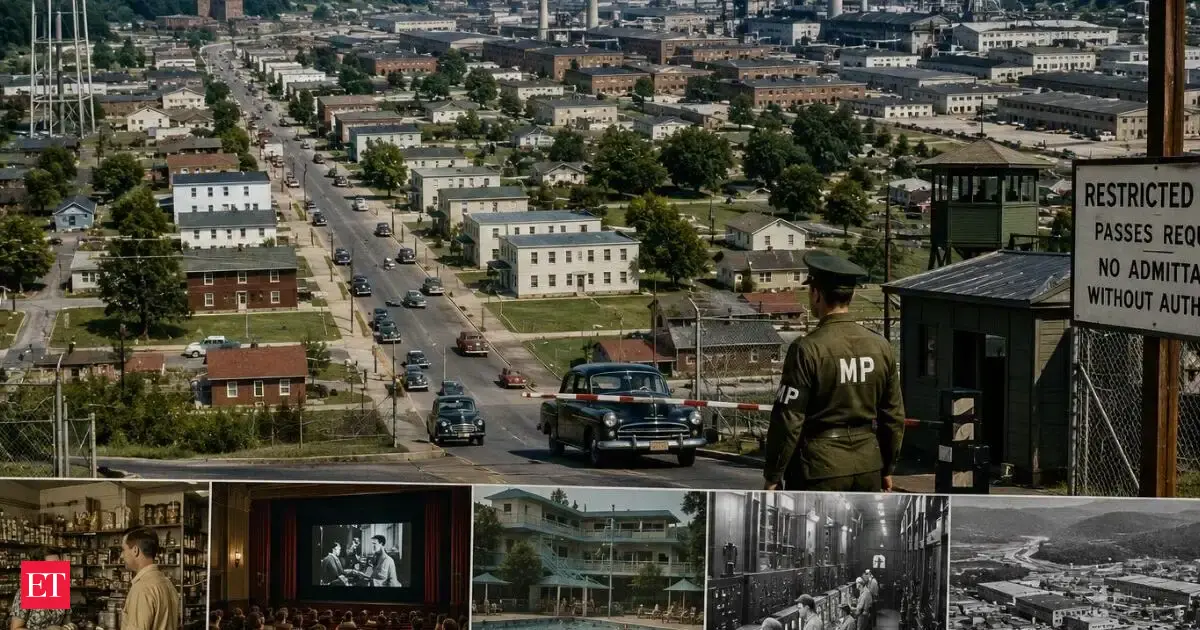
A City That “Didn’t Exist”
When Japan attacked Pearl Harbor in December 1941, Oak Ridge didn’t exist at all. There was no city, no name, nothing but quiet farmland tucked into the valleys of East Tennessee.
Also Read: Gray Hair Reason Found: A Japanese study explains why people get grey hair and it may be linked to cancer
Then, in 1942, the US government quietly began buying up roughly 60,000 acres of that farmland ‘on land framed by the foothills of the Appalachian Mountains’. Families who had lived there for generations were told to pack up and leave, often with only a few weeks’ notice, no explanation given, and no say in the matter.
By July 1943, the takeover became official. An army captain handed Tennessee’s governor a proclamation, straight from President Franklin Roosevelt, declaring the land a total exclusion area no longer under state control. The governor reportedly tore it up on the spot. It didn’t matter. The federal government now controlled the land, no questions asked.

Why This Sleepy Valley?
The location wasn’t chosen by accident. Oak Ridge sat far from either coast, making it an unlikely bombing target, and its valleys offered natural cover, plus room to separate massive industrial plants in case something went catastrophically wrong.
It was also cheap and remote, sparsely populated, which meant fewer people to notice, and fewer people to ask questions. Within months, this “nowhere” spot became one of three secret sites, alongside Los Alamos, New Mexico, and Hanford, Washington, chosen to build the world’s first atomic bomb as part of the Manhattan Project.
Life Behind the Fence
What rose out of that Tennessee mud was almost unbelievable. By its peak, Oak Ridge was home to ‘75,000 people, making it the fifth-largest city in Tennessee’, bigger than many cities that actually appeared on maps.
And yet, officially, it was blank space. Guards stood at every entrance. Every resident wore a badge at all times. Access required special approval, and visitors were essentially banned. Locals in nearby Knoxville reportedly knew something odd was happening, Oak Ridge workers were recognizable by their mud-caked shoes, a giveaway of the town no one was supposed to talk about.
Inside the fence, life looked almost normal, grocery stores, dances, churches, swimming pools. But almost nobody living there understood the true purpose of their own jobs. Workers were given fragments of tasks with zero context, deliberately kept in the dark so that even if information leaked, it wouldn’t add up to anything useful. One young chemist who arrived in 1943 later recalled being warned never to say the word “uranium” again after his very first day.
Some estimates suggest Oak Ridge briefly used more electricity than New York City, largely to power the massive uranium enrichment plants humming day and night behind the checkpoints.
When the Secret Finally Came Out
The truth broke in August 1945, when the U.S. dropped atomic bombs on Hiroshima and Nagasaki. Only then did the outside world, and most of Oak Ridge’s own residents, learn what they’d actually built: the enriched uranium used in the first atomic weapon ever deployed in war.
Also Read: Humans have a ‘third eye’ in the brain: Study links it to a 600-million-year-old Cyclops ancestor
Even after that, Oak Ridge stayed a closed, gated city for years. It wasn’t until March 1949 that its roads finally opened to the public, ending seven years of total secrecy.
What’s Left Today
Oak Ridge is no longer hidden, it’s a real, mapped city near Knoxville, and part of it is now preserved as the Manhattan Project National Historical Park. Visitors can tour surviving facilities, ride a scenic train along old supply routes, and see remnants of the plants that once ran around the clock behind armed checkpoints.
It remains one of the most remarkable facts of American history: for seven years, tens of thousands of people lived, worked, and raised families in a city the federal government built from nothing, and then simply erased from every map in the country.
Comments are closed, but trackbacks and pingbacks are open.