
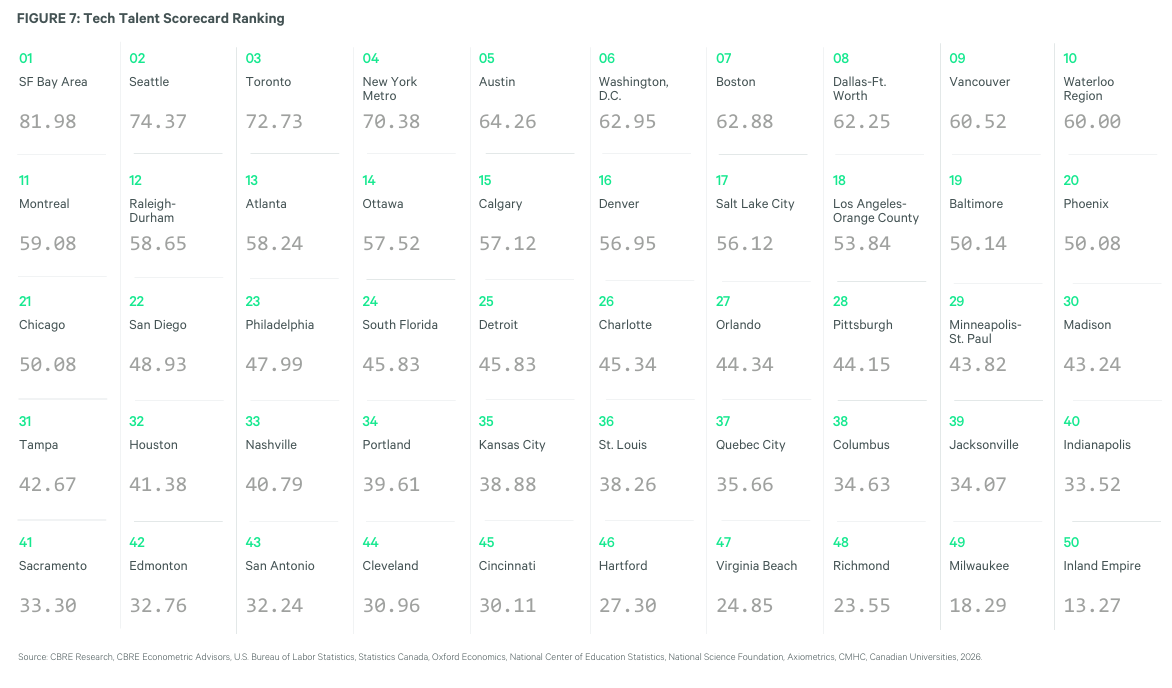
The Seattle region outranked New York, Austin, Boston and other tech hubs, trailing only the Bay Area, in an annual tech talent scorecard from commercial real estate firm CBRE that weighs factors such as tech worker concentration, wages, education levels and real estate costs.
You may have seen headlines this week that New York overtook the Bay Area for the first time in the CBRE rankings. That was based on a subset of the data: a straight head count in each market. New York’s 394,300 tech workers topped the Bay Area’s 375,730. Seattle ranks seventh on that specific list, with 213,010 tech workers across the region.
But in the broader scorecard, Seattle held onto the No. 2 spot (which it also occupied last year), thanks to the density of its tech workforce, one of the largest concentrations of AI talent in North America, and the second-highest tech wages on the continent.
The market-by-market workforce figures in the report run through 2025, so this year’s layoffs aren’t reflected in the rankings. CBRE does flag the trend nationally: the tech industry accounted for a record 31% of all U.S. job cuts through June, up from 13% for all of last year.
Some of the Seattle region’s specific strengths:
The AI workforce is deep.Seattle is home to 41,591 workers with AI skills, third most in North America, behind the Bay Area and New York. One in five of the region’s tech workers now has AI skills — a higher share than anywhere except the Bay Area.
Tech is a bigger part of the economy here.Tech jobs make up 10.2% of all employment in the metro area, among the top five markets and nearly double the 5.5% average across the 50 markets studied in the CBRE report.
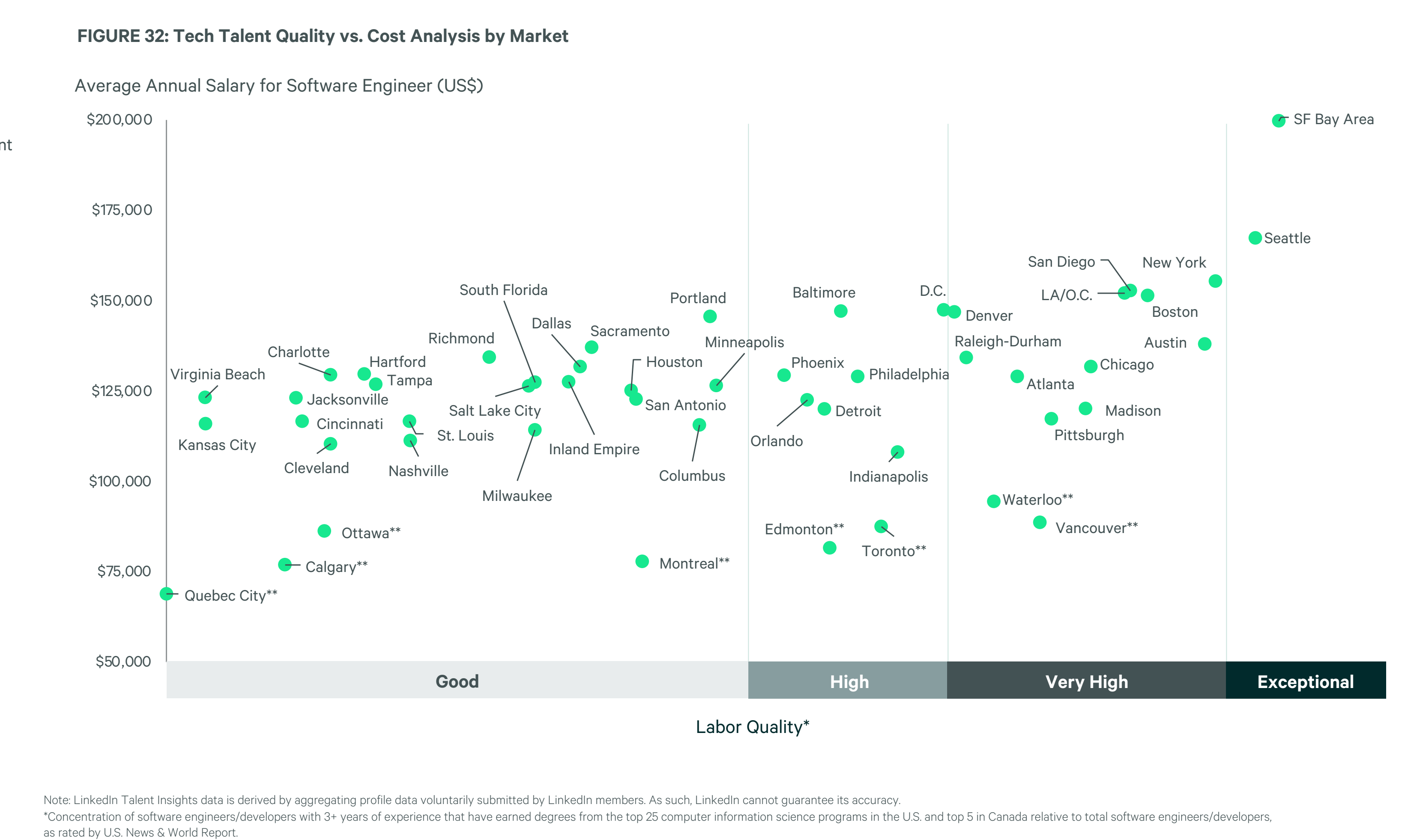
Wages are in a tier of their own.Seattle’s average wage for tech workers at tech companies was $190,050 in 2024, second to the Bay Area’s $211,048, and nearly $50,000 above third-place Boston.
The workforce grew while the Bay Area’s shrank. Seattle added 24,590 tech jobs from 2022 to 2025, a 13.1% increase and the fifth-largest gain of any market. The Bay Area lost 23,900 jobs over the same time period.
However, the report also points to warning signs:
Many offices are sitting empty. The Seattle metro area’s office vacancy rate hit 28.6% in the fourth quarter of 2025 — the highest of the 50 markets in the report. That’s despite 1.9 million square feet leased by AI companies across the region since 2023, according to CBRE.
Costs are near the top. Seattle is the third-most-expensive place to run a 500-person tech company, at $73.9 million a year in wages and office rent, behind the Bay Area at $90.6 million and slightly behind New York, which edged Seattle by about $24,000.
Young workers are going elsewhere.Seattle’s 20-something population fell between 2019 and 2024, even as its share of 30-somethings grew to the highest of any market in the report. The region is drawing mid-career but not entry-level talent, which risks creating a thinner pipeline over time.
One counterweight to the pipeline concern: the University of Washington ranks fifth among U.S. universities for its AI program, according to CBRE’s analysis of U.S. News & World Report rankings — the only school outside the Bay Area, Boston and Pittsburgh in the top five.
Access the full CBRE Scoring Tech Talent 2026 report here.
Comments are closed, but trackbacks and pingbacks are open.