
Home sprouting quickly stops being a curiosity and becomes a daily habit. It doesn’t require much space or experience, yet it delivers real results in the form of fresh additions to everyday meals. What matters most, however, is not the idea itself, but how each step is carried out. Even a simple process can lead to poor results if the basics are overlooked. Well-selected sprouting seeds and a structured approach make the entire routine repeatable and easy to maintain.
Sprouting seeds – how to choose good seeds to start with?
The first step is choosing the right seeds, which in practice determines the entire process. Not all seeds are suitable for home sprouting. Those intended for sprouts are properly prepared and safe for consumption. At the beginning, it is best to choose varieties that are predictable and quick:
- radish – fast growth and a bold flavor,
- broccoli – mild and versatile,
- peas – more substantial and slightly sweet.
Good sprouting seeds should germinate evenly. If some of them fail to grow or the process is highly uneven, it is usually a sign of poor quality. It is better to rely on a trusted source from the start and avoid unnecessary problems.
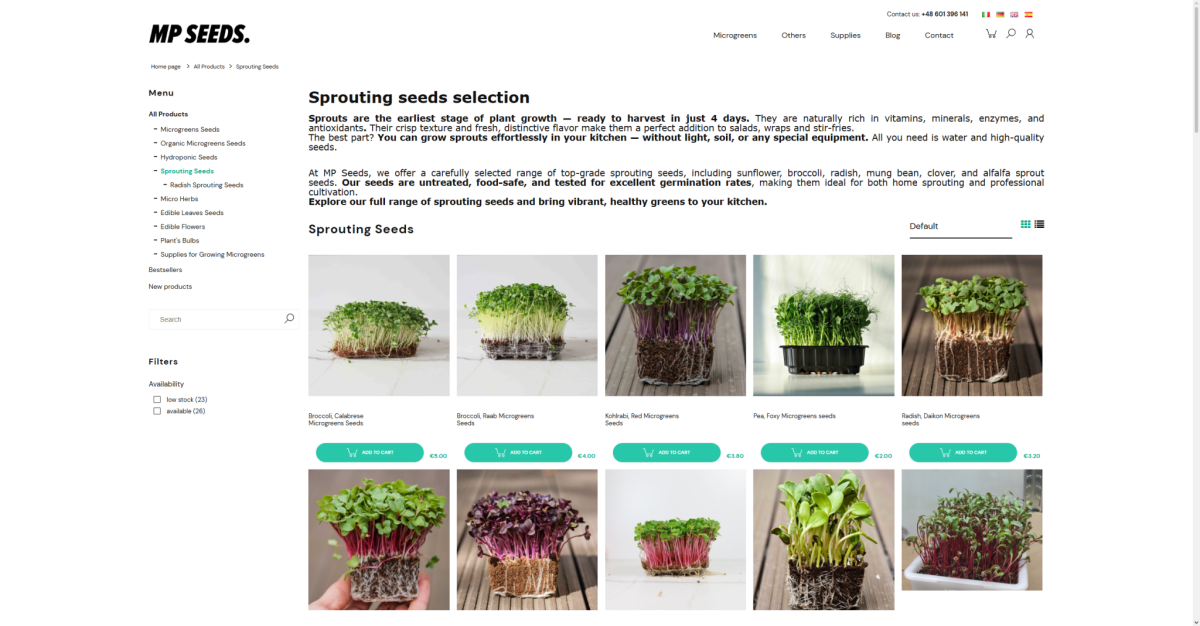
Your trusted partner in professional and home growing. Find certified and rigorously tested sprouting seeds at MP Seeds.
Preparing seeds – a step you should not skip
Soaking is often underestimated, but in practice it has a significant impact on the final result. It allows the seeds to begin germination at the same time. How to do it properly:
- measure a small portion of seeds,
- cover them with lukewarm water,
- leave them for several hours, usually between 6 and 12.
After soaking, the seeds should be thoroughly rinsed. They need to be clean and well hydrated, but should not remain in water. This is the point where the actual growing process begins.
Home growing step by step – what the sprouting process looks like
The most common methods are using a jar or a sprouter. Both work on the same principle – they provide airflow and allow for regular rinsing. The basic process looks like this:
- place the soaked seeds in a container,
- keep them in a bright place, but not in direct sunlight,
- rinse them 2–3 times a day,
- drain excess water thoroughly.
The process usually takes a few days. During this time, the sprouts gradually develop and increase in volume. Sprouting seeds mainly require consistency – lack of rinsing or too much moisture quickly leads to problems.
Conditions that directly affect the quality of sprouts
Although the process is simple, several factors have a direct impact on the final result. Controlling them helps avoid common mistakes. The most important elements include:
- temperature – moderate, room level,
- air circulation – poor ventilation can cause spoilage,
- moisture – necessary, but without excess water,
- light – indirect, not harsh or direct sunlight.
Too high a temperature may speed up growth, but can reduce quality. On the other hand, lack of light affects appearance and structure. It is best to choose one stable location and follow a consistent routine.
The most common mistakes in home sprouting
Many people give up after the first attempt, usually because of repeated mistakes. Eliminating them makes the whole process much easier. The most frequent issues are:
- too many seeds in one container,
- irregular rinsing,
- leaving water without proper drainage,
- not checking seed freshness.
Sprouting seeds need space and airflow. When they are packed too tightly, some begin to spoil instead of growing. This is one of the most common reasons for unsuccessful attempts.
When sprouts are ready and how to store them?
The right harvest time depends on personal preference. Some prefer shorter sprouts, others more developed ones. Usually, they are ready after a few days, once they reach the desired length. After harvesting, it is best to rinse them thoroughly, gently dry them, store them in a closed container in the refrigerator. This helps maintain freshness for several days. It is important not to store them with excess moisture, as it shortens their shelf life.
How to use sprouting seeds in everyday cooking?
Sprouts work best as an ingredient that can be added to meals without planning. This makes them a real part of the diet rather than an occasional addition. They can be used:
- in sandwiches and breakfasts,
- in salads and simple lunches,
- as an addition to warm dishes,
- as an element that improves both flavor and texture.
Different sprouting seeds create different effects, so it is worth having several varieties at once. This makes it easier to match them to a specific dish without changing your overall cooking style.
Why home growing of sprouting seeds is worth it?
The biggest advantage is independence. Having your own sprouting seeds means you are not dependent on store availability. It also allows you to control quality and freshness.
This approach provides:
- access to fresh sprouts all year round,
- the ability to choose preferred flavors,
- consistent results with minimal effort.
Over time, the process becomes automatic. Just a few minutes a day are enough to maintain continuity.
Start home growing and use sprouting seeds in practice
The best approach is to start with one variety and gradually expand. Sprouting seeds show results quickly, which makes it easier to build a habit. If you stay consistent and take care of the basic conditions, home growing will become a simple and natural part of your everyday kitchen.
Comments are closed, but trackbacks and pingbacks are open.