
The mayor’s difficulty in handling a question on Irish unification wasn’t entirely his fault. But it was also a trap he should have seen coming.
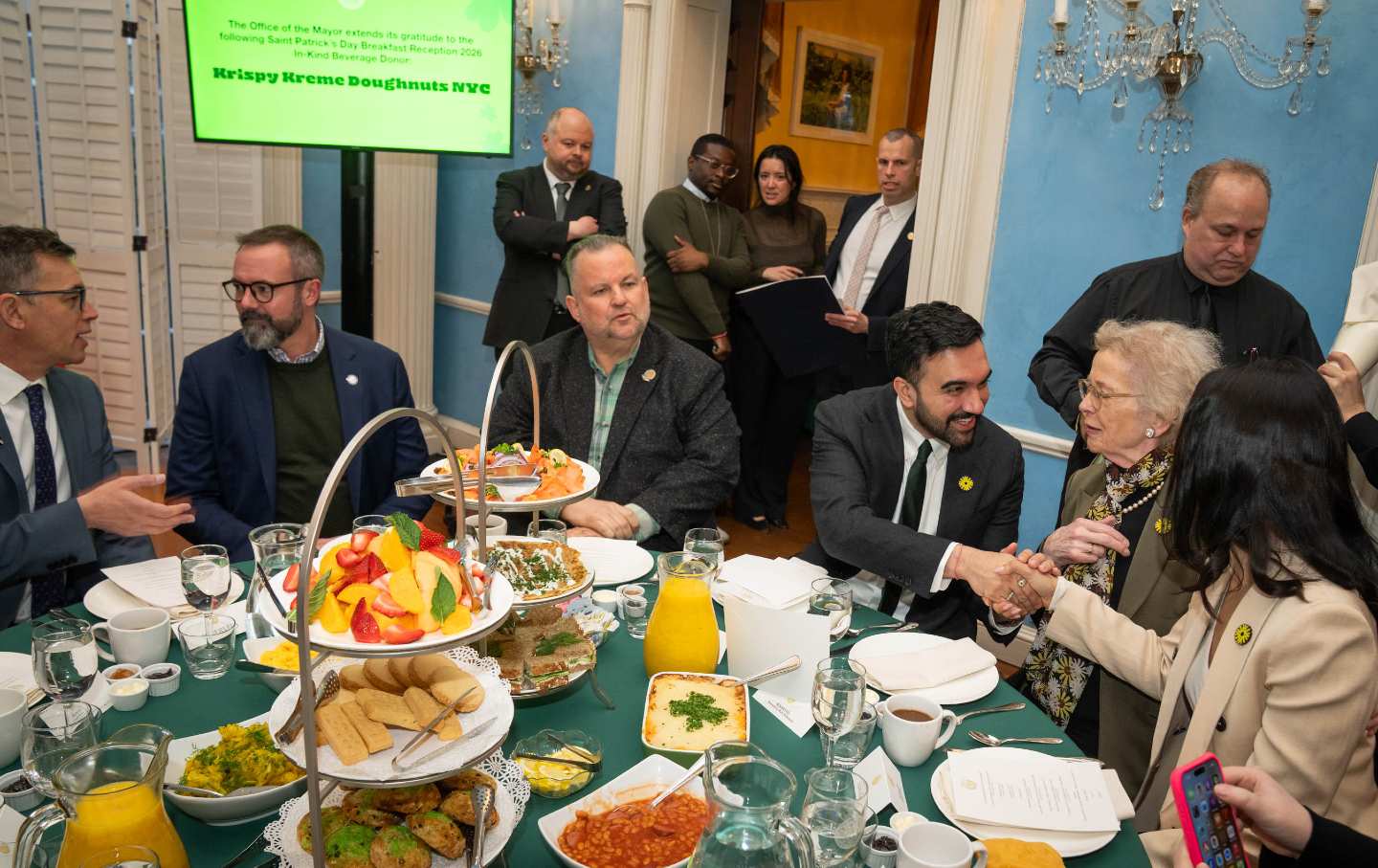
New York City Mayor Zohran Mamdani sits next to former Irish president Mary Robinson at a St. Patrick’s Day breakfast at Gracie Mansion on March 17, 2026.
(Ed Reed / Mayoral Photography Office)
On Monday, New York Mayor Zohran Mamdani was asked a question he obviously wasn’t expecting: “Do you support a United Ireland?”
There are two short, non-evasive responses that would have effectively disposed of the matter. He could, like Governor Kathy Hochul (whose roots go back to County Kerry) have said simply, “Indeed I do.” Or he might have noted that as mayor of New York he had constituents on both sides of that question, and that ultimately it was “for the people of Ireland to decide.”
Instead, the mayor began by laughing, before going on to admit, “I’ve got to be honest, I haven’t thought enough on that question.” Perhaps he should have. Because if the setting was indeed unlikely—the mayor and his transportation commissioner, Mike Flynn, were at Flushing International High School to announce a new 15 mph speed limit around the city’s schools—the timing was all but inevitable. The following morning, Mamdani was scheduled to host the good and great among New York’s Irish at a breakfast at Gracie Mansion marking the city’s 256th annual St. Patrick’s Day festivities. And it had only been a few days since the mayor had been invited by John Samuelson, head of the Transport Workers Union and an important Mamdani ally, to speak at a St. Patrick’s Day luncheon sponsored by the James Connolly Irish American Labor Coalition.
The mayor’s confession brought a quick rap on the rhetorical knuckles from Samuelson, who told AM New Yorkhe had “no doubt Zohran will wholeheartedly support the quest for a united Ireland.” Samuelson ascended to his union’s international presidency in 2017 from New York Local 100—which under his leadership backed Bernie Sanders in the New York Democratic primary the previous year.
But when I ran into Samuelson at the pre-parade breakfast he dismissed the fuss over what he described as “a cautious answer by a new mayor.”
“I don’t think the mayor can be expected to be on top of the demographic geopolitics of every community in New York City,” Samuelson added. On Tuesday morning the union leader, who still lives in the heavily Irish American Gerritsen Beach neighborhood in Brooklyn, was seated on the mayor’s right hand. Mary Robinson, who rose from the Dublin Corporation council to become Ireland’s first woman president, was to the mayor’s left.
Mamdani presented an official proclamation honoring Robinson, who after she left the presidency served as the United Nations high commissioner for human rights. In his remarks, he recalled “how she stood steadfast alongside the people of Palestine” when so many others remained silent. Noting that “so much of the exploitation later imposed elsewhere across the world was first honed in the plantations of Ireland,” Mamdani celebrated the island nation’s long history of struggle: “When I think of the Irish, I do not think first of oppression. I think of resistance. I think of unity. I think of corned beef and 96-minute Troy Parrott goals, and the Pogues’ ‘Fairytale of New York.’”
Current Issue

Yet when he was asked again about Irish unification while marching in Tuesday’s parade, the mayor, describing himself as “someone who believes deeply in the principle of self-determination,” merely said that principle, “should be extended to the Irish”—a response that quickly drew some flak on social media.
That, too, shouldn’t have come as a surprise. There was, it’s true, once a time when the mayor of New York was not expected to have a foreign policy. When the dapper young Irish American Mayor Jimmy Walker sailed to Europe in the fall of 1932, that was an exit strategy for the corrupt incumbent, not an act of statesmanship. Previous mayors had remained in the five boroughs, as did Walker’s successor, Fiorello La Guardia, despite a peripatetic childhood that took him from Arizona to Fiume and Budapest, and service on the Italian front in World War I.
It was Bill O’Dwyer, who as it happens was New York’s last Irish American mayor, who inaugurated what became a City Hall tradition with a 34-day trip to Israel in 1951. Though he made that sojourn just after leaving office, the Irish-born (County Mayo) O’Dwyer had strong ties to the Jewish state. In 1949 he’d proclaimed Israel Independence Day as a city holiday; his younger brother Paul, who later served as president of the New York City Council, had run guns for the Irgun—and in the 1970s provided legal defense to Americans accused by the Nixon administration of performing a similar service for the Irish Republican Army. Yet such visits soon came to be viewed as obligatory by O’Dwyer’s successors, which made Mamdani’s break with such expectations during a Democratic primary debate so shocking—and refreshing.
To some of us, Mamdani’s election, despite—or perhaps because of—his refusal to recite the standard Zionist shibboleths seemed little short of miraculous. Of course, many Jewish New Yorkers share the mayor’s disenchantment with Israel. For others, the issue was less important than his commitment to affordability, and to building a New York that truly belongs to the people who live here.
Still, in New York as elsewhere most Jews retain some kind of interest in the survival of the Jewish state, meaning that when topic comes up Mamdani—who is not only pro-Palestinian but the city’s first Muslim mayor—seems aware of the need to tread carefully. His deftness in doing so was for me best summarized by a photo released by City Hall, and which Jacob Kornbluh, senior political reporter for The Forward, posted earlier this month showing Mamdani breaking his Iftar fast with a plate of hamantaschen (the triangular pastries Jews eat to celebrate Purim).
As for just how far Mamdani’s opponents will go to demonize him, the most recent evidence for that was the controversy—which if you aren’t on social media you might well have remained in blissful ignorance about—over an illustration his wife provided for a collection of short stories by writers in Gaza. When it emerged that the collection’s editor had referred to Jews as “vampires” and “parasites,” adding, “I also don’t give a shit if people collapse the distinction between zionists [and] jews,” the mayor duly condemned her rhetoric as “patently unacceptable. I think it’s reprehensible.” That is doubtless true—-though even some of us on the receiving end might question the decency of expending so much energy on tone-policing when children in Gaza and the West Bank are still being murdered.
But as this week’s Irish excursion demonstrated, Israel and Palestine are not the only foreign policy minefields for a mayor. As a candidate, Mamdani said he’d probably skip many of the city’s ethnic parades, yet he has already made exceptions for the Irish and for Chinese New Year.
Popular
“swipe left below to view more authors”Swipe →
It would be surprising, indeed, if he showed up on May 18, when the Israel Day Parade—the successor to Bill O’Dwyer’s celebration—marches down Fifth Avenue under the theme ”Proud Americans, Proud Zionists.” But if the mayor is going to continue having a foreign policy, he might consider adopting some of the skepticism toward the claims of all nationalisms found in the pages of his father’s books. Unbendingly radical and yet resistant to the rhetorical cant that too often mars progressive support for “liberation struggles”—especially those comfortingly far from the speaker’s home—Mahmood Mandami’s work, in particular his 2022 study Neither Settler Nor Native, offers a vision of citizenship and agency independent of both blood and soil.
Perhaps the mayor could borrow a copy the next time he visits his folks.
Even before February 28, the reasons for Donald Trump’s imploding approval rating were abundantly clear: untrammeled corruption and personal enrichment to the tune of billions of dollars during an affordability crisis, a foreign policy guided only by his own derelict sense of morality, and the deployment of a murderous campaign of occupation, detention, and deportation on American streets.
Now an undeclared, unauthorized, unpopular, and unconstitutional war of aggression against Iran has spread like wildfire through the region and into Europe. A new “forever war”—with an ever-increasing likelihood of American troops on the ground—may very well be upon us.
As we’ve seen over and over, this administration uses lies, misdirection, and attempts to flood the zone to justify its abuses of power at home and abroad. Just as Trump, Marco Rubio, and Pete Hegseth offer erratic and contradictory rationales for the attacks on Iran, the administration is also spreading the lie that the upcoming midterm elections are under threat from noncitizens on voter rolls. When these lies go unchecked, they become the basis for further authoritarian encroachment and war.
In these dark times, independent journalism is uniquely able to uncover the falsehoods that threaten our republic—and civilians around the world—and shine a bright light on the truth.
The Nation’s experienced team of writers, editors, and fact-checkers understands the scale of what we’re up against and the urgency with which we have to act. That’s why we’re publishing critical reporting and analysis of the war on Iran, ICE violence at home, new forms of voter suppression emerging in the courts, and much more.
But this journalism is possible only with your support.
This March,The Nationneeds to raise $50,000 to ensure that we have the resources for reporting and analysis that sets the record straight and empowers people of conscience to organize. Will you donate today?
More from The Nation
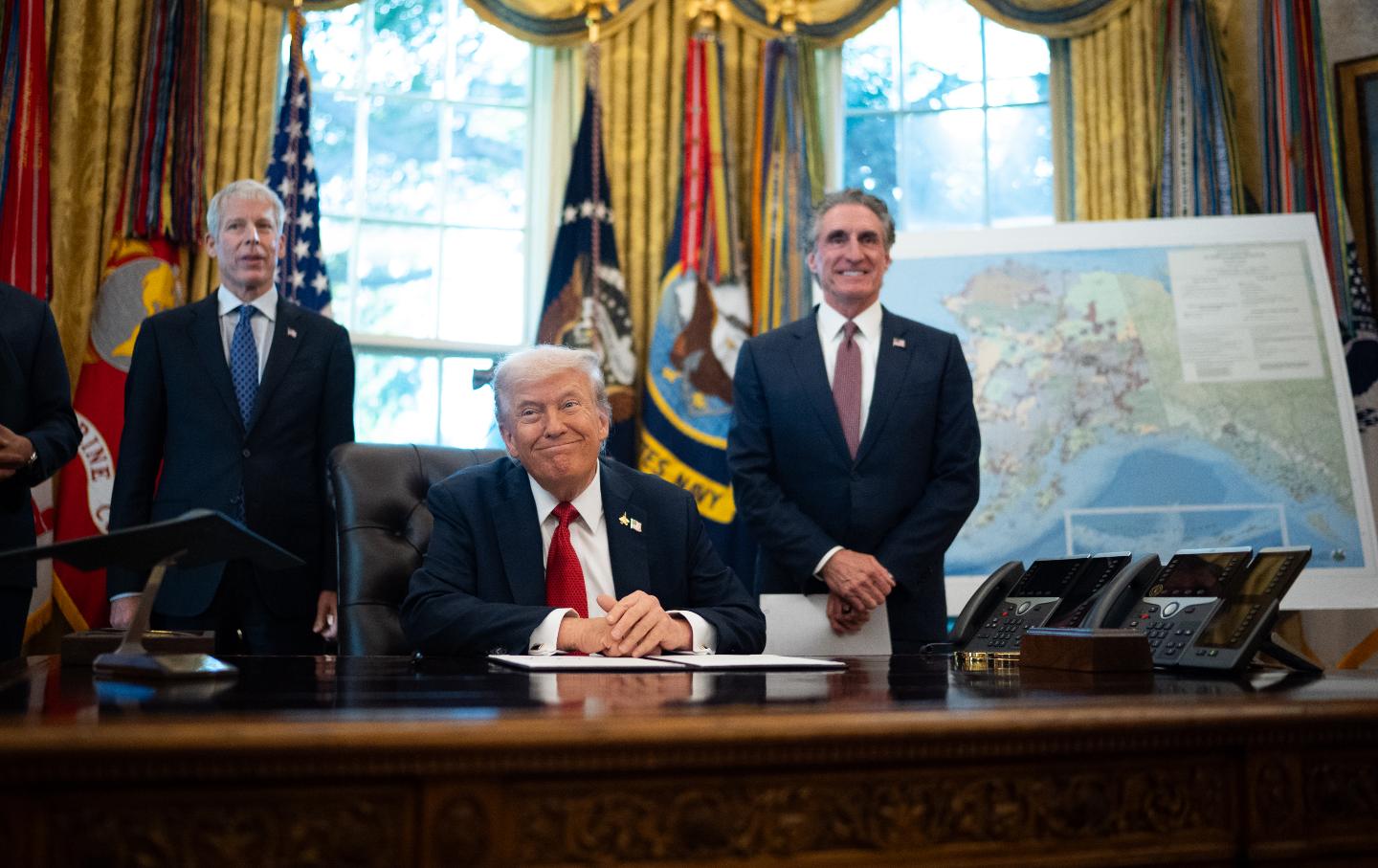
A natural gas pipeline has been proposed once again in the 49th state, but advocates and critics alike are skeptical.
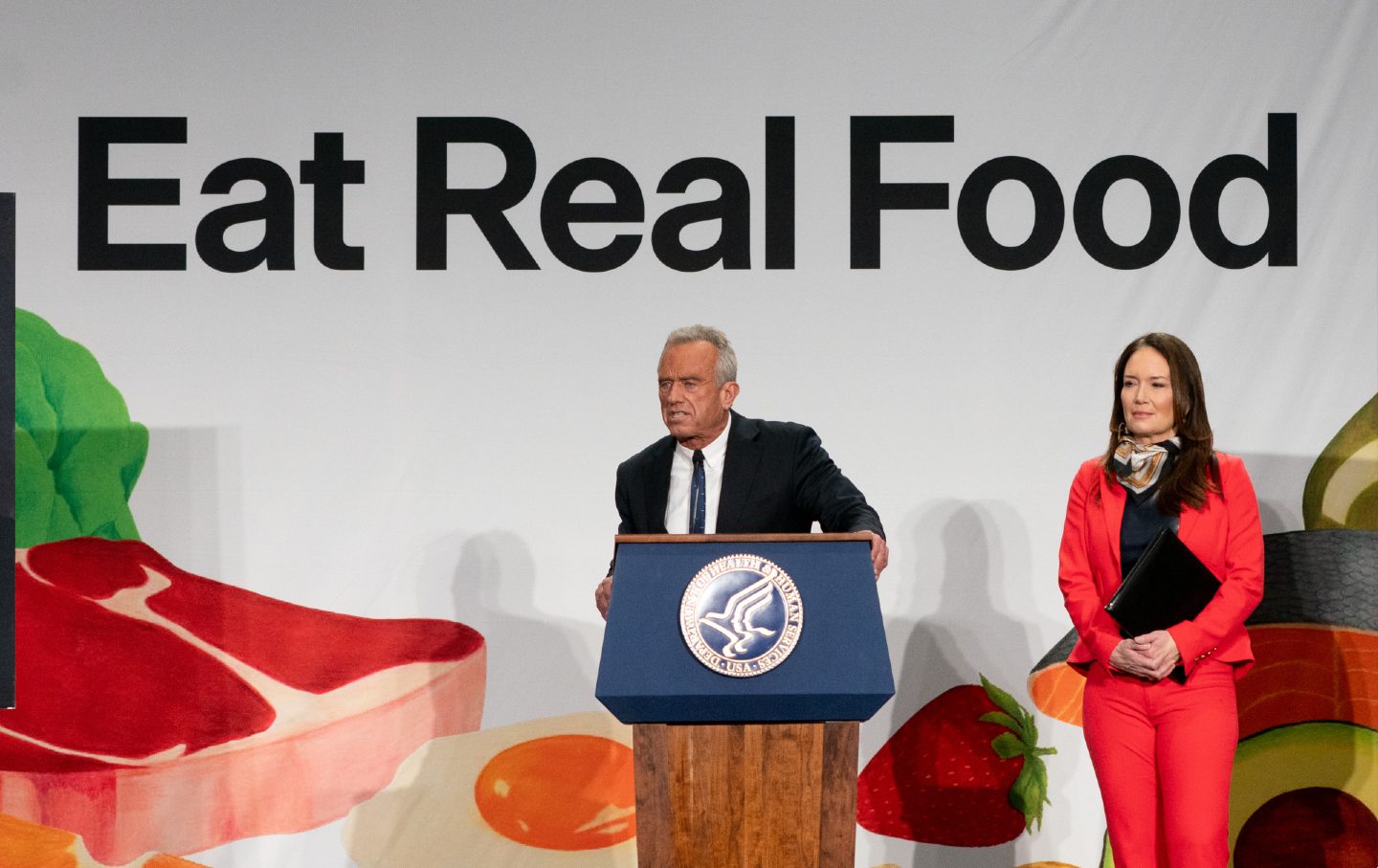
The right is summoning its armies via their stomachs. When we dismiss food politics, risk missing what’s being stirred when a group coheres itself around the table.
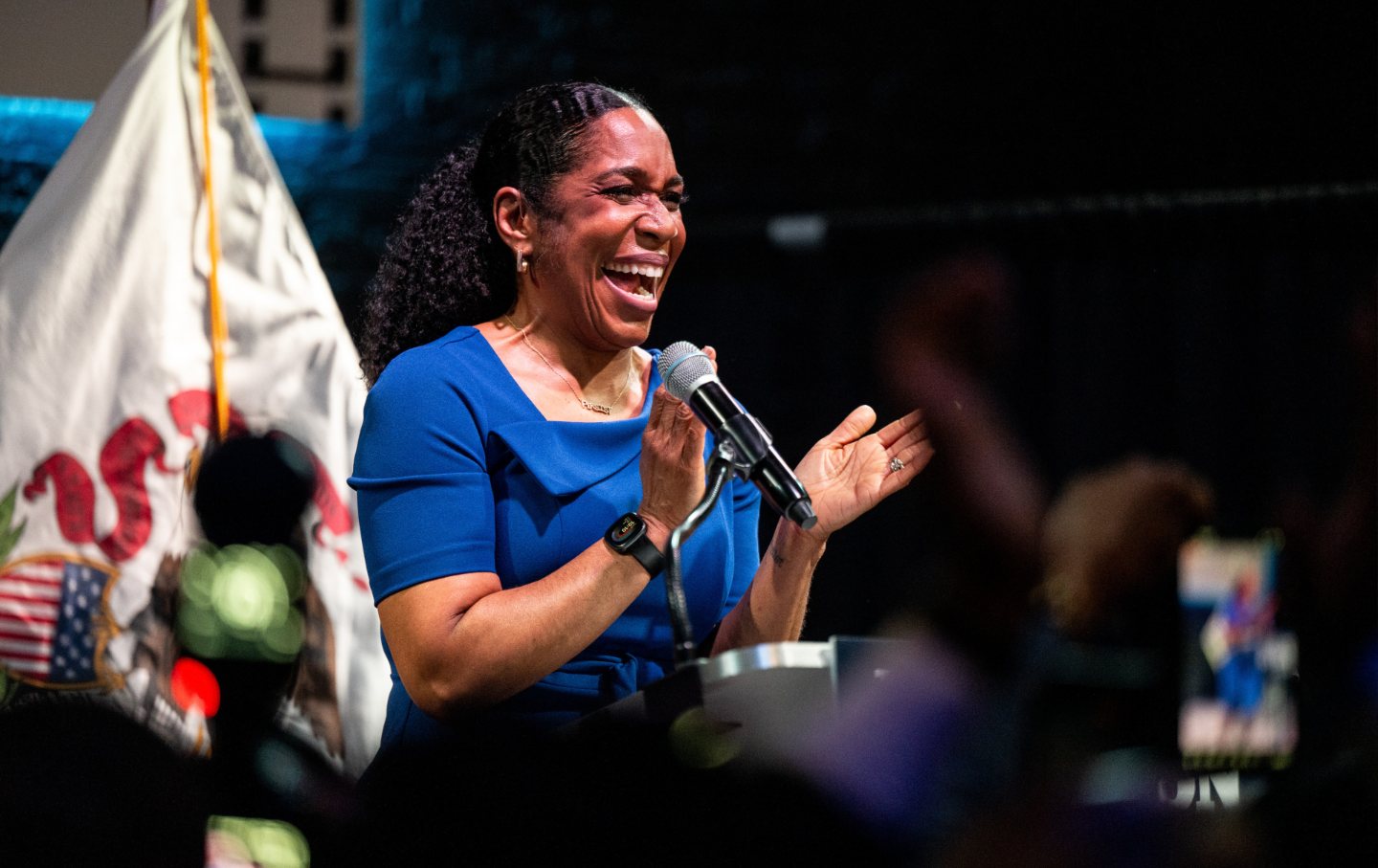
Lieutenant Governor Juliana Stratton was buoyed by millions spent by Governor JB Pritzker, but she won a tough race on her own merit.
Laura Flanders speaks with Christopher Armitage and Sumathy Kumar about “soft secession” and building a government that actually works for people.
Comments are closed, but trackbacks and pingbacks are open.