
Dozens of civilians, including children, wounded by an Iranian drone strike in Bahrain. France deploying warships to secure shipping commerce in the Strait of Hormuz. Australia taking heat from President Trump over its handling of the Iranian women’s soccer team. Markets across Asia plunging as the price of oil surged.
Lebanon reporting half a million people displaced by fighting between Israel and Hezbollah. The U.S. State Department telling nonessential staff to get out of Saudi Arabia after attacks there killed workers from India and Bangladesh. Ukrainian anti-drone experts turning their attention from their war with Russia to help intercept Iranian attacks. The defense minister of ever-neutral Switzerland saying his country believes the U.S.-Israeli war violates international law.
In less than two weeks, the Trump administration has instigated a truly global conflict — and with no quick and clear path to resolution, despite Trump insisting to congressional Republicans gathered at his Miami resort Monday that it would be a “short term excursion.”
“Short term! Short term!” Trump said in a bullish speech about the conflict, in which he said “the world respects us right now more than they have ever respected us before.”
“We’re counting down the minutes until they will be gone,” he said of Iran’s remaining leadership, while adding that the U.S. “will not relent” until Iran is “totally and decisively defeated.”
The war is not isolated to Iran, though it has certainly caused devastation there — with more than 1,300 deaths reported and toxic clouds from strikes on fuel depots hovering over Tehran, a city of some 10 million people.
The war’s effects also are not limited to the Middle East, though they are widespread there — as Israel has pushed into Lebanon and Iran has launched a wave of retaliatory strikes on U.S. allies across the Persian Gulf. The fighting has grounded regional air traffic, threatened desalination facilities that provide drinking water to millions and undermined the safe reputation of modern metropolises such as Dubai and Abu Dhabi.
Unlike the recent U.S. incursion into Venezuela to capture and oust President Nicolás Maduro, the U.S. war on Iran has been met with stiff resistance militarily, drawn in a slew of allies, reignited proxy battles, drastically destabilized the oil trade and shifted dynamics between the U.S. and other major powers such as China and Russia.
China, which gets upward of 50% of its crude oil imports through the Strait of Hormuz, has largely stayed out of the conflict, though China’s Foreign Minister Wang Yi said Sunday that the war “should never have happened” and “benefited no one.”
Trump said Monday that the U.S. is less harmed by strait disruptions, and was “really helping China” by securing the strait.
Russia, meanwhile, has emerged the lone winner of energy disruptions in the region, said Robert David English, a UCLA international policy analyst — as the Trump administration considers reducing oil sanctions on Russia to take pressure off of Mideast sources.
Trump said he had a “good talk” with Russian President Vladimir Putin about Iran on Monday. He also said the U.S. was going to suspend sanctions against other countries in order to alleviate strain on oil markets while the Iran conflict persists, but did not provide specifics.
The scope of the war has been dictated in part by Iran, which has historically limited its responses to U.S. strikes but warned after the U.S. bombed its nuclear sites last summer that it would treat any new attacks — large or small — as an act of war, and respond in kind.
Its strikes on U.S. facilities and allies throughout the region reflect that strategy, and are aimed in part at making the war more politically costly for the U.S. by straining global markets and its regional allies, experts said.
However, “you can’t attribute the increasingly global characteristics of the conflict solely to an Iranian strategy, because wars in this region tend to spill over the longer they last, with unintended consequences” including “bringing in all kinds of actors that don’t want to be involved,” said Kevan Harris, an associate professor of sociology who teaches courses on Iran and Middle East politics at the UCLA International Institute.
That can serve as a deterrent to starting wars in the region, he said, but “also makes them more difficult to wind down.”
The surge in oil prices to nearly $120 a barrel Monday — before a remarkable reversal to below $90 by the time U.S. stocks closed — is one of the furthest-reaching effects of the war, and one that clearly had Trump’s attention.
“Short term oil prices, which will drop rapidly when the destruction of the Iran nuclear threat is over, is a very small price to pay for U.S.A., and World, Safety and Peace. ONLY FOOLS WOULD THINK DIFFERENTLY!” Trump wrote on social media Sunday.
How long prices will remain elevated or volatile is a matter of debate, but Trump’s “short term” projections have been undercut by increasing strikes on oil and gas facilities in the region.
“If you can tolerate oil at more than $200 per barrel, continue this game,” Ebrahim Zolfaghari, a spokesperson for Iran’s Islamic Revolutionary Guard Corps, said Sunday.
Prices at the pump have surged for average Americans, some of whom were attracted to Trump’s candidacy because of his promises to avoid foreign wars and focus on driving down the cost of living for U.S. citizens.
Now, Trump and other administration officials are facing questions about their own role in putting the world at war, and offering various different justifications. They’ve asserted without proof that the U.S. faced an imminent threat of attack from Iran. Trump has repeatedly hinted that his goal was removing the government.

President Trump speaks at the Republican Members Issues Conference on Monday at Trump National Doral Miami in Doral, Fla.
(Mark Schiefelbein / Associated Press)
In the meantime, Iran has shown no signs of bowing to Trump, rejecting his calls for “surrender” and for him to have a say in naming their next leader. Iran installed Mojtaba Khameneiafter Trump said the hard-liner son of the late Ayatollah Ali Khamenei would be “unacceptable.”
The choice was hailed by the president of Azerbaijan and the leader of Yemen’s Houthi rebels, among other allies.
To date, seven U.S. service members have been killed in the conflict, according to U.S. officials. Every day, U.S. taxpayers are on the hook for nearly $1 billion in war costs, according to one estimate. Democrats have slammed Trump for both.
“This war is coming from the same President that is building a $400 million ballroom in the White House. The same President that says $100 for a barrel for oil is worth it. The same President that doubled healthcare premiums for millions of Americans. But we have money for another endless war?” Sen. Alex Padilla (D-Calif.) wrote Monday on X.
Other world leaders focused on the global economic impact.
Traffic through the Strait of Hormuz, which transports about 20% of the world’s oil, has nearly halted, while producers in Saudi Arabia, Iraq, Kuwait and the United Arab Emirates ceased oil operations without open routes for export.
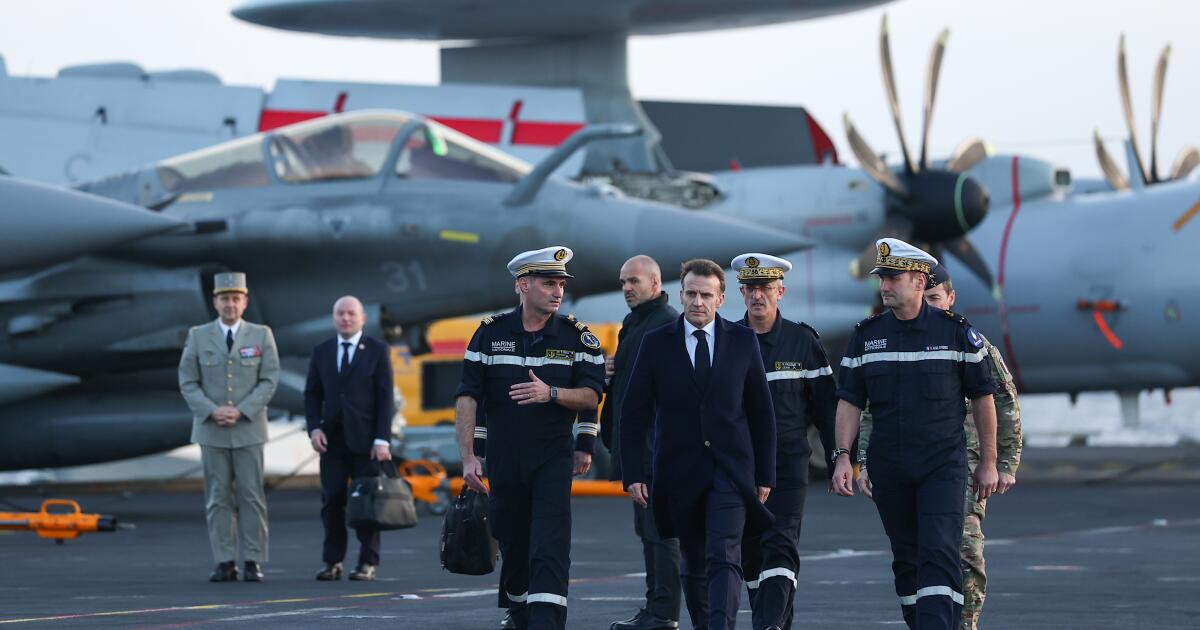
In response, French President Emmanuel Macron suggested French and other allied naval assets could escort oil tankers in the strait, shifting the security burden there from Washington onto Europe, leaving European vessels vulnerable to hostilities and potentially drawing the European Union deeper into the conflict.
Already, they’ve agreed to allow the U.S. to use bases in their territories, though the U.S. and Spain got into a spat after Spain rejected U.S. use of its bases and Trump threatened U.S. trade with the country.
Macron on Monday also threw additional military support behind Cyprus, following a meeting with Cypriot President Nikos Christodoulides and Greek Prime Minister Kyriakos Mitsotakis at a Cyprus air base.
France will dispatch an additional 11 warships to operate across the eastern Mediterranean, the Red Sea and the Strait of Hormuz, Macron said, after an Iranian drone struck a British military base on Cyprus on Monday.
“When Cyprus is attacked, it is Europe that is attacked,” Macron said.
Located just 150 miles from Israel in the eastern Mediterranean, the island of Cyprus has emerged as a strategic — and exposed — nerve center in the U.S. offensive against Iran. It hosts vital British military bases and acts as an intelligence, surveillance, and logistics hub in countering Iranian influence and proxy attacks.
Britain’s Defense Secretary John Healey said Monday that the United Kingdom was conducting air defense to support the UAE, and that Typhoon jets had taken out two drones — one over Jordan and the other headed to Bahrain.
Trump suggested Monday that the U.S. was on the path toward victory, but acknowledged it had not accomplished all of its goals.
“We’ve already won in many ways, but we haven’t won enough,” he said — adding the conflict will end “pretty quickly.”
He said Iran had been “very foolish, very stupid” when it attacked its neighbors, hurting its own chances of success in resisting the U.S.
“Their neighbors were largely neutral, or at least weren’t gonna be involved, and they got attacked,” Trump said. “And it had the reverse effect. The neighbors came onto our side, and started attacking them.”
Iran may still attempt to widen the conflict’s economic and geopolitical impact to keep up pressure and push for a ceasefire in its favor, but that could also backfire, said Benjamin Radd, a political scientist and senior fellow at the UCLA Burkle Center for International Relations.
“Iran’s becoming increasingly like North Korea in this sense,” he said, “isolating itself further.”
Comments are closed, but trackbacks and pingbacks are open.